

The 10-Minute Morning Routine That Primes Your Brain
Let’s talk about what most vet students do in the first ten minutes after their alarm goes off. They pick up their phone. They check Instagram or TikTok or their messages or the news or all four simultaneously. They lie there in a semi-conscious state absorbing a random stream of information that has nothing to do with what they need to learn today. By the time they get out of bed, their brain has already spent its first focused attention of the day on content that will not help them pass their pharmacology exam.
This is not a judgment. This is a description of what the human brain defaults to when left to its own devices in the modern world. Phones are engineered by some of the most sophisticated behavioral psychologists alive to capture and hold attention. You are not weak for picking yours up. You are just not being strategic about it.
Here is what ten minutes of intentional behavior before you open a single textbook can do for your cognitive performance that day. The science behind it is solid, the time investment is minimal, and it costs nothing except the willingness to do something slightly uncomfortable for the first few days until it becomes automatic.
Why the First 10 Minutes Matter More Than You Think
When you wake up, your brain transitions out of a sleep state through something called the hypnopompic period — a window of about 20 to 30 minutes where your neural patterns are unusually flexible and receptive. Neuroscientists sometimes call this a state of heightened neuroplasticity. In plain language: your brain is more ready to learn in the first part of the morning than at almost any other point in the day.
Most people immediately flood this window with passive content consumption. Social media, email, news. These activities activate your brain’s reward circuitry and stress responses before you’ve had a chance to set your own cognitive agenda for the day. Research from the University of Sussex found that morning phone use is one of the strongest predictors of anxiety levels throughout the rest of the day.
The alternative is not a two-hour wellness ritual. It is ten minutes of deliberate activity that primes your prefrontal cortex — the part of your brain responsible for complex reasoning, focus, and memory — before you ask it to do the hardest work of your day.
Your brain is more ready to learn in the first part of the morning than at almost any other point in the day. Most people immediately flood that window with social media.
The Routine: What to Do and Why It Works
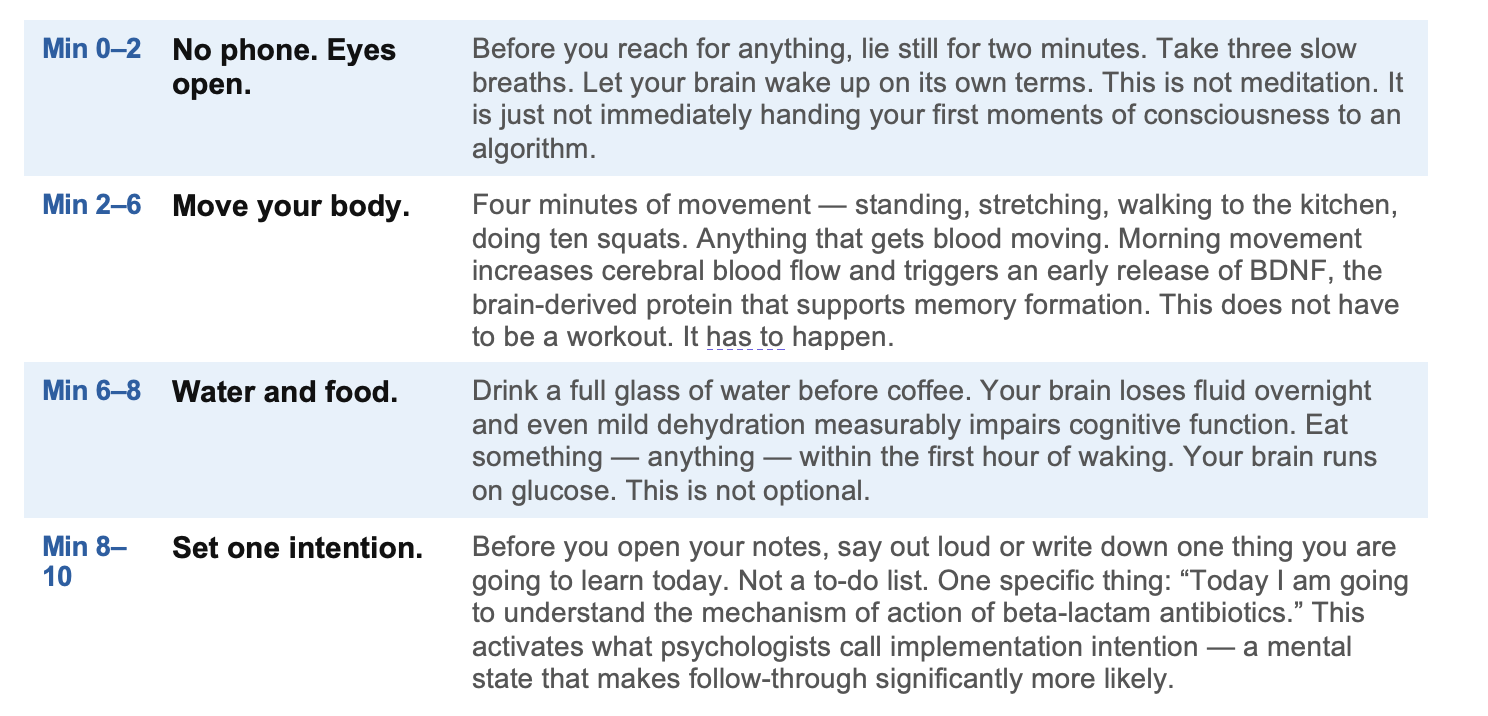
This is a ten-minute sequence. It is not ten minutes of yoga followed by ten minutes of journaling followed by a cold shower and a green smoothie. It is ten actual minutes, broken into three parts. You can do this before coffee. You can do it in your dorm room. It requires no equipment. That’s it. Ten minutes. You can add to it over time if you want. But start with this and only this, because a routine you actually do is worth more than a perfect routine you abandon by week two.
The Science Behind Each Piece
The no-phone rule
A 2019 study published in the Journal of Experimental Psychology found that the mere presence of a smartphone — even face down, even off — reduces available cognitive capacity. Having it in another room during your morning routine and your study blocks is not a minor lifestyle choice. It is a measurable performance intervention.
Movement before cognitive work
John Ratey, a Harvard Medical School psychiatrist and author of Spark: The Revolutionary New Science of Exercise and the Brain, has spent decades documenting the relationship between physical movement and cognitive function. Even brief movement — we are talking about four minutes of light activity — increases levels of norepinephrine, dopamine, and serotonin in the brain. These are the same neurotransmitters targeted by the medications commonly prescribed for ADHD and depression. Morning movement is the cheapest, fastest-acting cognitive enhancer available to you.
Hydration before caffeine
You lose approximately 500ml of water during an average night of sleep through respiration and perspiration. Caffeine is a diuretic that accelerates further fluid loss. Starting your morning with coffee before water compounds your overnight dehydration at exactly the moment when your brain needs to be at its sharpest. One glass of water first. Then coffee. The order matters.
Implementation intention
Psychologist Peter Gollwitzer has published over thirty years of research demonstrating that forming a specific “when-then” plan before a task dramatically increases the likelihood of completion. Saying “I will study beta-lactam mechanisms during my first block this morning” is not just motivational self-talk. It creates a mental link between a cue (sitting down to study) and a specific behavior (what you will study) that your brain will activate automatically. Students who use implementation intention before study sessions outperform those who don’t, even when total study time is identical.
Even brief movement increases levels of norepinephrine, dopamine, and serotonin in the brain — the same neurotransmitters targeted by medications for ADHD and depression. Morning movement is the cheapest cognitive enhancer available to you.
What You’re Not Doing in the Morning (And Why It’s Costing You)
The average American spends 23 minutes on social media first thing in the morning. If you are doing this, you are starting every study day with 23 minutes of dopamine stimulation that makes the comparatively quiet experience of reading anatomy notes feel unbearably boring. You are also spending 23 minutes in passive consumption mode when your brain is at its most neuroplastic and receptive.
This is not a moral failing. Social media platforms are specifically designed to exploit the neurological state you are in when you first wake up. The algorithms know you are vulnerable in the morning. The entire business model depends on capturing you before you are fully awake and aware enough to choose differently.
You are training to be a veterinarian. You are going to spend the next four years making rapid, high-stakes cognitive decisions under pressure. The single most important skill you can build during that time is the ability to direct your own attention deliberately. Your morning routine is where that skill gets practiced every single day before anything else happens.
For the Scrubs Who Are Not Morning People
This section is for you specifically, because the “I’m not a morning person” identity is one of the most durable and least examined beliefs that vet students carry into their first year.
Chronobiology — the science of how biological rhythms affect human function — does establish that people have genuine differences in natural sleep-wake timing. Some people have later chronotypes and are neurologically wired to be more alert later in the day. This is real.
However, the research also shows that chronotype is not fixed. It is malleable, particularly in response to consistent light exposure, meal timing, and activity patterns. And more importantly for our purposes: vet school does not care about your chronotype. Your 8am anatomy lab does not negotiate. Your licensing exam is not scheduled around your preferences.
The ten-minute routine described above requires no particular love of mornings. It requires only that you do not immediately pick up your phone. That is the entire ask. Everything else follows from that one choice.
The ten-minute routine requires no particular love of mornings. It requires only that you do not immediately pick up your phone. That is the entire ask.
Start This Tomorrow
Tonight, before you go to sleep, put your phone on the other side of your room. Not face down on your nightstand. The other side of your room, or in a different room entirely.
When your alarm goes off tomorrow, you will have to get up to turn it off. That is intentional. You are already up. You have already done the hardest part of the morning. Now drink a glass of water. Move your body for four minutes — walk to the bathroom, do some stretches, go outside for sixty seconds if you can. Eat something before your first class. Write down one thing you are going to learn today.
Ten minutes. Then open your notes.
Do it for five days in a row and notice what is different. Your focus in the first study block will be sharper. Your recall at the end of the day will be better. You will feel less behind, not because you studied more, but because the studying you did actually worked.
The Scrubs who make it through year one intact are not the ones who were naturally smarter or more disciplined. They are the ones who figured out, earlier than everyone else, that how you start the day determines everything that follows.
Scrub Squad · Day 2 of 99 · Body
This article is part of the Scrub Squad 99-day program from Vet Candy. Free for every first-year vet student. Earn your De-Scrub certificate on Day 99.
