

The Study Schedule That Actually Works
Why six hours of distracted cramming is worse than two hours of focused misery
You already know you have too much to study. You probably already have a highlighter in your hand and a playlist going and three tabs open and a snack you've been eating for the last forty minutes. You're physically present at your desk. You feel like you're studying. You are not studying.
Here's the thing nobody tells you in orientation: the number of hours you sit in front of your notes is almost completely irrelevant. What matters is the quality of the cognitive work happening inside those hours. And most vet students, especially in year one, are producing almost none of it.
This is not a character flaw. It's a training problem. You were never taught how to study. You were taught how to survive, and for most of undergrad, surviving was enough. Vet school is different. The volume is different. The stakes are different. And the old approach will bury you.
The good news is that the science on this is extremely clear, and the fix is simpler than you think.
Your Brain Has a Closing Time
In the 1990s, psychologist K. Anders Ericsson published research that changed how experts think about expert performance. He studied musicians, athletes, chess players, and surgeons. The ones who reached the highest levels of mastery were not the ones who practiced the most hours. They were the ones who practiced with the most concentrated focus, in shorter blocks, with real rest in between.
The ceiling for genuinely productive cognitive work is about four hours per day. Not four hours of sitting at a desk. Four hours of deep, focused, distraction-free engagement with hard material. Beyond that, your brain's ability to encode new information degrades sharply. You can keep going. You will feel like you are working. The material simply will not stick.
Vet students routinely report studying eight, ten, twelve hours a day. Most of them are producing the cognitive equivalent of about two.
The ceiling for genuinely productive cognitive work is about four hours per day. Not four hours of sitting at a desk. Four hours of actual focus.
What Distracted Studying Actually Does to You
Every time you check your phone, glance at a notification, or switch between tabs, your brain pays what researchers call an "attention residue" tax. Your focus doesn't instantly return to the material when you look back at it. A portion of your cognitive capacity stays stuck on whatever you just looked at, sometimes for up to 20 minutes.
In a six-hour study session with moderate phone use, you might be paying that tax forty or fifty times. You're not studying for six hours. You're studying for maybe ninety minutes of actual focused engagement, fragmented into pieces too small to build real memory.
There is also what happens at the neurological level. Memory consolidation, the process by which short-term information becomes long-term knowledge, requires something called elaborative encoding. Your brain has to actively connect new information to what it already knows. That process requires sustained attention. It cannot happen in the spaces between distractions. You can read the same page of anatomy notes twenty times in a distracted state and remember almost none of it.
The Pomodoro Technique Is Not Just a Productivity Hack
In the 1980s, Francesco Cirillo developed a time management method using a tomato-shaped kitchen timer. He called it the Pomodoro Technique, and it works like this: you study in focused 25-minute blocks, take a five-minute break, and after four rounds you take a longer 20-30 minute break. No phone during the block. No exceptions.
The method spread because it works, and it works because it maps onto how the brain actually functions. Short, intense blocks prevent the attention fatigue that makes long sessions counterproductive. The forced breaks give your brain the downtime it needs to begin consolidating what you just learned. The structure removes the decision fatigue of constantly choosing whether to take a break.
There is nothing magic about 25 minutes specifically. Some people work better in 45-minute blocks with 15-minute breaks. The principle is the same: time-boxed intensity followed by real rest. Real rest means walking away from the material entirely. It does not mean switching to Instagram.
Real rest means walking away from the material entirely. It does not mean switching to Instagram.
The Schedule That Actually Works
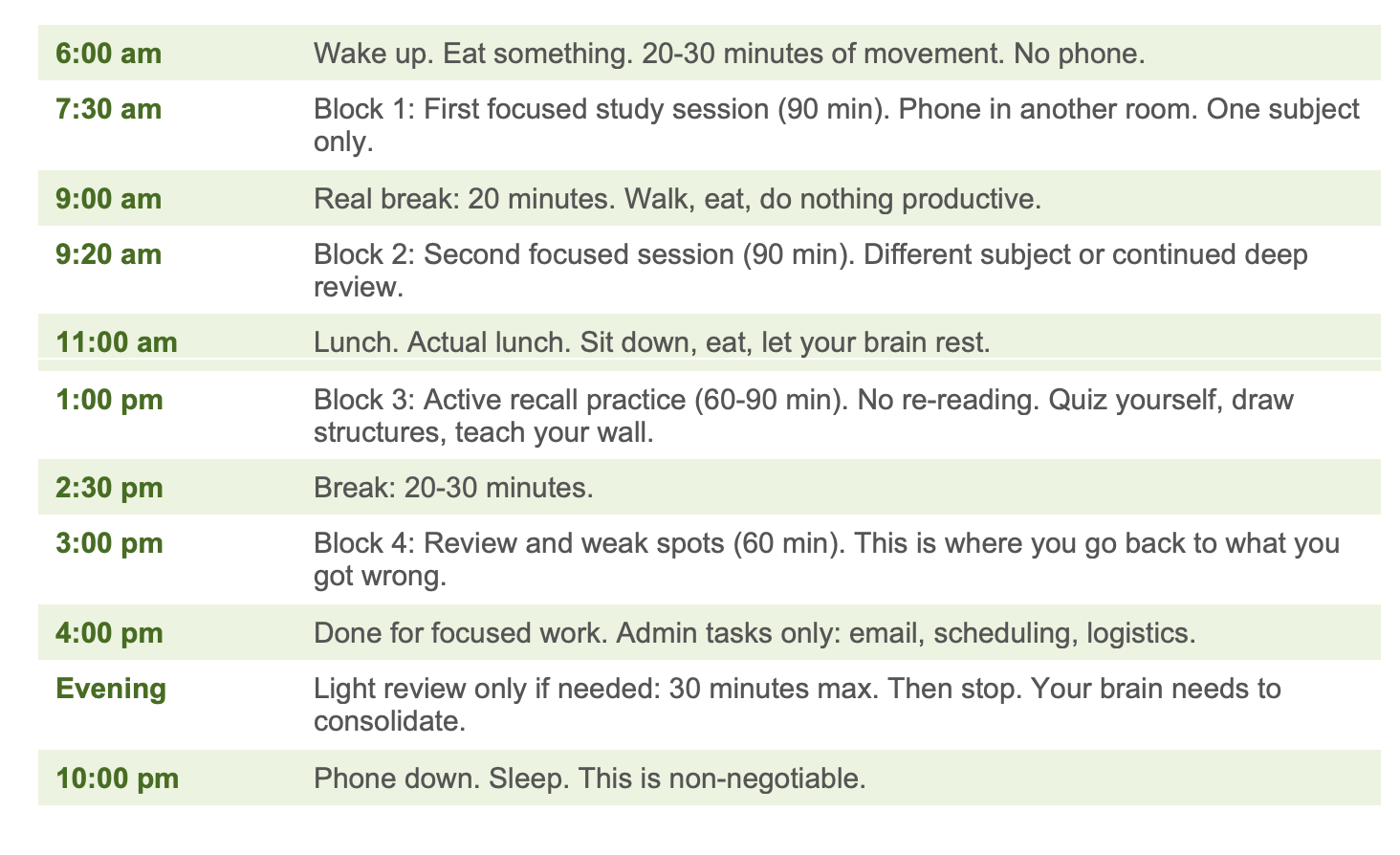
Based on the research, here is what a productive study day looks like for a first-year vet student. This is not aspirational. This is what the evidence supports.
That is roughly five and a half hours of focused work. It will produce more than twice the learning of a ten-hour distracted session, and you will not burn out by week three.
The One Rule That Overrides All of This
If you do nothing else from this article, do this: study one thing at a time. Not physiology with pharmacology open in another tab. Not anatomy while listening to a podcast about something interesting. One subject. One block. Full attention.
Multitasking does not exist, not for complex cognitive tasks. What you call multitasking is your brain rapidly switching between two things, paying the attention residue tax on every switch, performing both tasks at a fraction of the quality you would achieve by doing them sequentially. You already know this. You have felt the difference between a conversation you were fully present for and one you were half-present for. Your studying works the same way.
Two hours of anatomy with your phone in another room and no music with lyrics will produce more lasting memory than six hours at your desk with everything on and running. That is not a motivational statement. That is what the research says.
A Note on Perfectionism and the Study Spiral
A lot of vet students, especially high-achieving ones who got here by outworking everyone around them, respond to academic pressure by studying more. More hours, more re-reading, more highlighting, more note-taking. This feels productive. It is often the opposite.
When you are tired and your brain has hit its consolidation ceiling, adding more input does not add more learning. It adds more fatigue. Fatigue makes retrieval harder. Harder retrieval makes you feel like you haven't learned anything. Feeling like you haven't learned anything makes you study more. This is the spiral, and it will swallow your first year if you let it.
The counterintuitive answer is to study less and rest more. Not to lower your standards. To be strategic about when and how you study so that the time you do spend actually works. The goal is not to be the Scrub who studied the most. The goal is to be the Scrub who learned the most and still has enough left to keep going for four years.
The goal is not to be the Scrub who studied the most. The goal is to be the Scrub who learned the most and still has enough left to keep going for four years.
Start Tomorrow
Pick one study block tomorrow. Just one. Put your phone in another room, close every tab except what you're studying, set a timer for 45 minutes, and don't stop until it goes off. Then take a real break.
Notice how different that feels from what you've been doing. Notice how much more you retain when you quiz yourself afterwards. Then do it again the next day.
You don't have to overhaul your entire schedule in week one. You just have to start doing one thing differently. Everything else follows from there.
Scrub Squad · Day 2 of 99 · Mind
This article is part of the Scrub Squad 99-day program from Vet Candy. Free for every first-year vet student. Earn your De-Scrub certificate on Day 99.
