

The Squad Does Not Suffer in Silence
How to find mental health support on a student budget — and why waiting until you’re in crisis is the wrong strategy
In 2008, researchers at Kansas State University published a study that should have changed how every veterinary school in the country talks to incoming students. They found that vet students reported significantly higher rates of psychological distress than medical students — including higher rates of depression, anxiety, and burnout. Not slightly higher. Significantly higher.
That study is over two decade old. The profession has not gotten less stressful since. The class sizes have not gotten smaller. The debt loads have not gotten lighter. The cultural expectation that veterinarians and vet students are supposed to simply absorb difficulty and keep moving has not meaningfully changed. What has changed is that more people are talking about it — which is the only reason to have hope that things might actually get better.
This article is not going to tell you to practice self-care or take bubble baths or download a meditation app, though none of those things are bad. This article is going to tell you something more practical: how to find a good therapist before you need one desperately, what to look for, what to avoid, and exactly where to find affordable options when you are living on a student budget that has already been stretched past its limit.
The Squad does not suffer in silence. That is not a platitude. It is a rule.
Why Vet Students Specifically
The KSU study prompted a follow-up question that researchers have been trying to answer ever since: why is veterinary medicine, specifically, so psychologically demanding compared to other health professions?
Several factors are consistently cited. First, vet students carry the same academic and clinical intensity as medical students but receive a fraction of the institutional mental health resources. Medical schools have been under pressure to address student wellbeing for decades. Vet schools are still catching up.
Second, the profession attracts a specific psychological profile: high-achieving, high-empathy individuals who are extremely hard on themselves. The same traits that make someone an extraordinary veterinarian — the deep caring, the refusal to accept failure, the drive to do more — are the same traits that make them vulnerable to perfectionism, imposter syndrome, and compassion fatigue.
Third, vet students face a grief load that is almost never discussed in orientation. You are going to witness death. You are going to make clinical decisions with outcomes you cannot fully control. You are going to form bonds with patients you will lose. No one prepares you for this. It starts earlier in training than most students expect, and it accumulates.
Fourth and most practically: you are in a new place, possibly far from your support network, surrounded by people who seem to be handling everything fine — because everyone is performing the same competence they do not actually feel.
The same traits that make someone an extraordinary veterinarian — the deep caring, the refusal to accept failure, the drive to do more — are the same traits that make them vulnerable to perfectionism, imposter syndrome, and compassion fatigue.
The Case for Starting Now, Before You Need It
Most people seek therapy when they are already in crisis. They wait until they are failing exams, crying every morning, unable to get out of bed, or having thoughts that scare them. By that point, the immediate goal of therapy becomes stabilization rather than growth — and stabilization takes longer than building a foundation before the storm.
Think of it the way you think about preventive medicine. You do not vaccinate a dog after it has contracted distemper. You vaccinate before exposure, when the immune system has the capacity to build protection. Your mental health works the same way. Starting therapy in week two of first year, when you are stressed but functional, is completely different from starting in week ten, when you are not.
There is also the practical matter of waitlists. Good therapists in university towns are often booked six to eight weeks out. If you wait until you need someone urgently, you may spend two months on a waitlist during the worst stretch of your first semester. Start the search now, before anything is wrong, and you will have someone in your corner when things get hard. And things will get hard. Not because you are failing. Because this is hard.
Starting therapy in week two, when you are stressed but functional, is completely different from starting in week ten when you are not. Good therapists are booked 6–8 weeks out. Start the search before you need it urgently.
The Difference Between a Therapist, a Counselor, and a Psychiatrist
These terms are often used interchangeably and they should not be. Understanding the difference matters for finding the right kind of support.
Licensed counselors and social workers (LPC, LCSW)
These are master’s level mental health professionals trained in talk therapy. They can be excellent and many are. They are also the most common and often the most affordable option through school counseling centers and platforms like BetterHelp. The limitation is that they cannot prescribe medication.
Psychologists (PhD, PsyD)
Doctoral-level clinicians with extensive training in assessment and therapy. They cannot prescribe medication in most states but are highly trained in evidence-based therapeutic approaches like cognitive behavioral therapy (CBT), which has the strongest research base for anxiety and depression. Often more expensive than master’s level counselors.
Psychiatrists (MD)
Medical doctors who specialize in mental health. They can prescribe medication and are the appropriate choice if you are managing something that may benefit from pharmacological support — significant depression, anxiety disorders, ADHD, or anything that feels bigger than situational stress. Some psychiatrists also do therapy. Many focus on medication management and work in conjunction with a separate therapist.
The recommendation is not that everyone needs a psychiatrist. The recommendation is that you should know the difference and not rule one out because of stigma. If you broke your wrist, you would see an orthopedic surgeon. If your brain chemistry is making it difficult to function, seeing a psychiatrist about whether medication is appropriate is the clinical equivalent of the same decision.
How to Find a Good Therapist: Three Rules
One size does not fit all. Shop around.
The therapeutic relationship is the single strongest predictor of positive outcomes in therapy — stronger than the therapist’s credentials, their modality, or their years of experience. If you meet with someone and the fit does not feel right after two sessions, try someone else. This is not failure. This is how it works. You would not stay with a primary care vet who consistently misread your patients. Do not stay with a therapist who does not feel right to you.
2. Look for someone who knows the medical training context.
Not every therapist understands what vet school is. A therapist who has worked with medical students, healthcare professionals, or graduate students under academic pressure will get to the useful work faster than someone who has to be educated about the environment before they can help you navigate it. When you contact a therapist, it is completely appropriate to ask: “Do you have experience working with professional students or healthcare training programs?”
3. Be honest in your first session, even when it is uncomfortable.
Therapy works when you tell the truth. The therapist cannot help with the version of yourself you are presenting to manage their impression of you. You are paying — or your insurance is paying — for someone to help you with the real thing. The real thing might be: I am terrified I made the wrong choice. I feel completely alone. I do not know if I am smart enough for this. I am having thoughts I am ashamed of. Whatever it is, say it in session one. The work starts there.
The therapeutic relationship is the single strongest predictor of positive outcomes in therapy — stronger than credentials, modality, or years of experience. If the fit does not feel right after two sessions, try someone else. That is how it works.
Low-Cost and No-Cost Options That Actually Work
The most common reason vet students give for not seeking therapy is cost. This is a real barrier and it deserves a real answer, not a dismissal. Here are specific options with honest descriptions of what to expect from each.
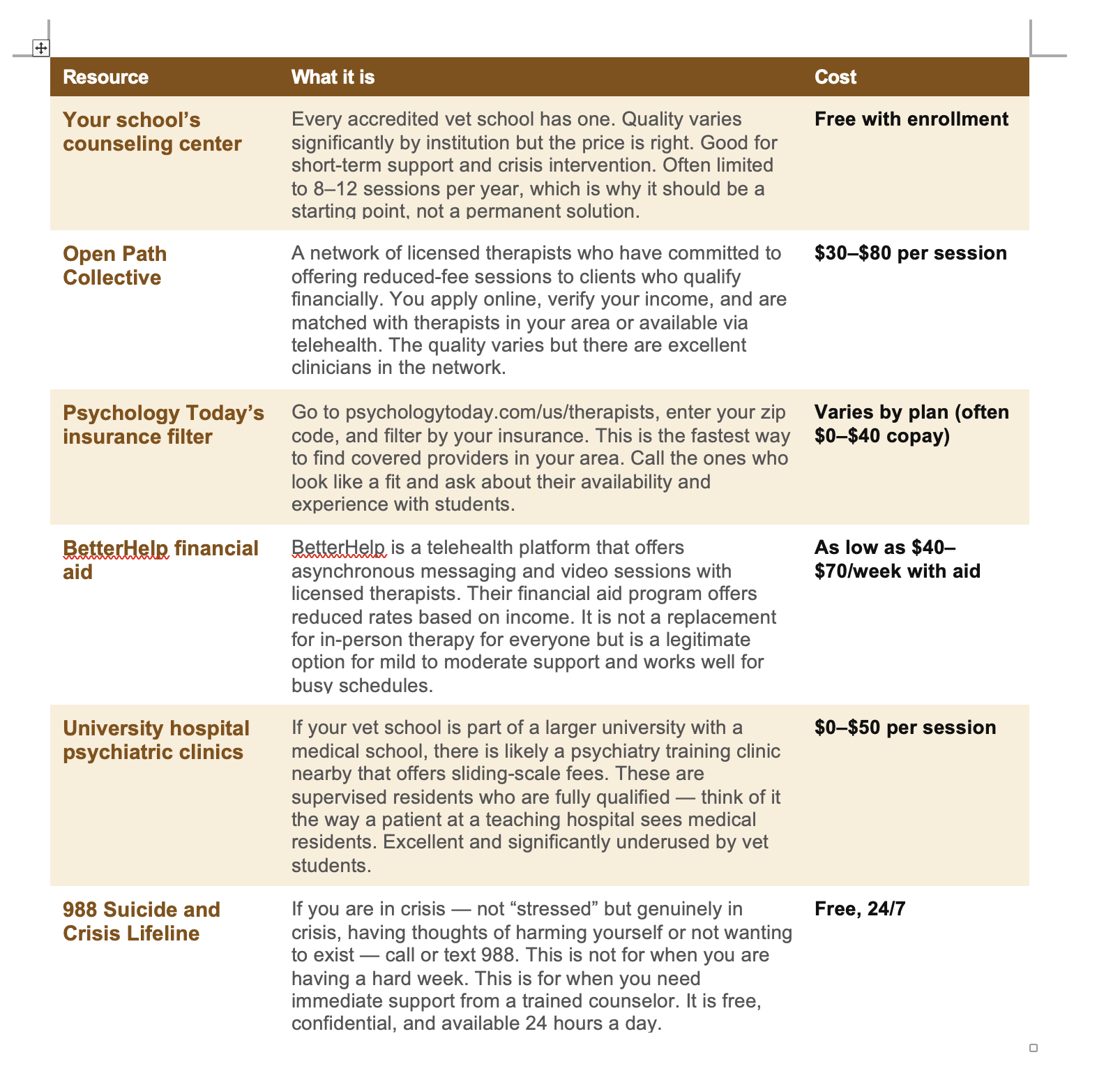
What to Say When You Call
A lot of people avoid making the call because they do not know what to say. Here is a script. Use it exactly if you want to.
WHAT TO SAY ON YOUR FIRST CALL
“Hi, I’m a student and I’m looking to start therapy. I’m not in crisis, I just want to get support in place before things get harder. Do you have availability, and do you have experience working with graduate or professional students? I’m also curious whether you accept [insurance name] or offer a sliding scale.”
That is the whole call. It takes three minutes. It tells the therapist what they need to know. It screens for fit in one exchange. If they say no to availability or no to relevant experience, you hang up and call the next one. This is not a big commitment. It is a phone call.
On the Culture of Not Asking for Help
Veterinary medicine has a culture problem. It is a culture that prizes toughness, competence, and self-sufficiency to a degree that actively harms the people inside it. The suicide rate among veterinarians is significantly higher than in the general population and higher than in most other professions. This is not coincidence. It is the downstream consequence of a professional culture that treats asking for help as weakness.
You are entering that culture at its beginning. You have the opportunity, right now in year one, to decide what your relationship with help-seeking is going to be for the rest of your career. The Scrubs who build that muscle early — who learn to say “I am struggling” before they are drowning — are the ones who last. They are the ones who still love their work in year fifteen. They are the ones who have the reserves to actually care for their patients, their staff, and themselves.
The Scrubs who white-knuckle through every hard thing and never ask for help are the ones who burn out in year seven and wonder what happened. You do not have to be that person. You are choosing right now, on Day 2 of 99, what kind of veterinarian you are going to be.
The veterinarian suicide rate is significantly higher than the general population. This is the downstream consequence of a professional culture that treats asking for help as weakness. You are choosing right now what your relationship with help-seeking will be for the rest of your career.
Your One Action Today
Look up your school’s counseling center. Find the website, find the phone number, and save it in your phone right now. Not when you need it. Now.
Then, when you have twenty minutes this week, go to psychologytoday.com/us/therapists and filter by your insurance or by sliding scale. Look at three or four profiles. Notice who you might want to talk to. You do not have to call today. But knowing who you would call is the difference between having a plan and not having one.
The Squad does not suffer in silence. This is the rule. It starts with you deciding, before anything goes wrong, that you are someone who asks for help. That decision is the bravest thing in this email.
This article is part of the Scrub Squad 99-day program from Vet Candy. Free for every first-year vet student. Earn your De-Scrub certificate on Day 99.
If you or someone you know is in crisis, call or text 988 (Suicide and Crisis Lifeline) anytime, 24/7.
