

How 10 Minutes of Daily Meditation Resets Your Brain
This is not a wellness article. This is neuroscience. And it applies to you specifically, right now, in vet school.
Here is what most vet students believe about meditation. They believe it is something that calm people do. People who have time. People who have figured out how to sit quietly without feeling like they should be studying. People who own crystals, or practice yoga, or do not have forty-eight hours of anatomy to cover before Thursday. They believe it is aspirational self-care, the kind of thing you will start doing once things settle down.
This article is going to dismantle that belief, not with motivational language but with peer-reviewed research from some of the most rigorous neuroscience institutions in the world. Because the evidence for what ten minutes of daily meditation does to the brain is now strong enough that calling it optional is like calling sleep optional. Technically you can skip it. Practically, the cost is higher than most people realize.
The version of meditation this article is describing is not mystical. It does not require a specific posture, a tradition, a teacher, a subscription, silence, or any particular belief system. It is a cognitive training practice with a measurable effect on brain structure, stress hormones, memory consolidation, and emotional regulation. It takes ten minutes. It requires nothing except the willingness to do it consistently.
If you are skeptical, this article is for you. Read the research first. Then make up your mind.
What Meditation Actually Is And What It Isn’t
The word meditation covers a wide range of practices, which is part of why it is so misunderstood. In the context of this article and the research discussed here, we are talking specifically about mindfulness meditation — a practice in which you deliberately focus your attention on a present-moment experience (typically the breath), notice when your attention wanders, and return it to the chosen focus without judgment.
That is the entire practice. Focus. Notice the wandering. Return. Repeat for ten minutes.
The noticing and returning is not a sign that you are failing at meditation. It is the meditation. Every time you notice that your mind has wandered and you deliberately redirect your attention, you are performing a cognitive rep. You are training the prefrontal cortex to exert executive control over the default mode network — the brain’s resting-state system that produces mind-wandering, rumination, and unfocused thought. Like any training, the adaptation comes from the repetition, not from any single session.
The noticing and returning is not a sign that you are failing at meditation. It is the meditation. Every redirect is a cognitive rep. You are training your prefrontal cortex to control mind-wandering. That is a study skill.
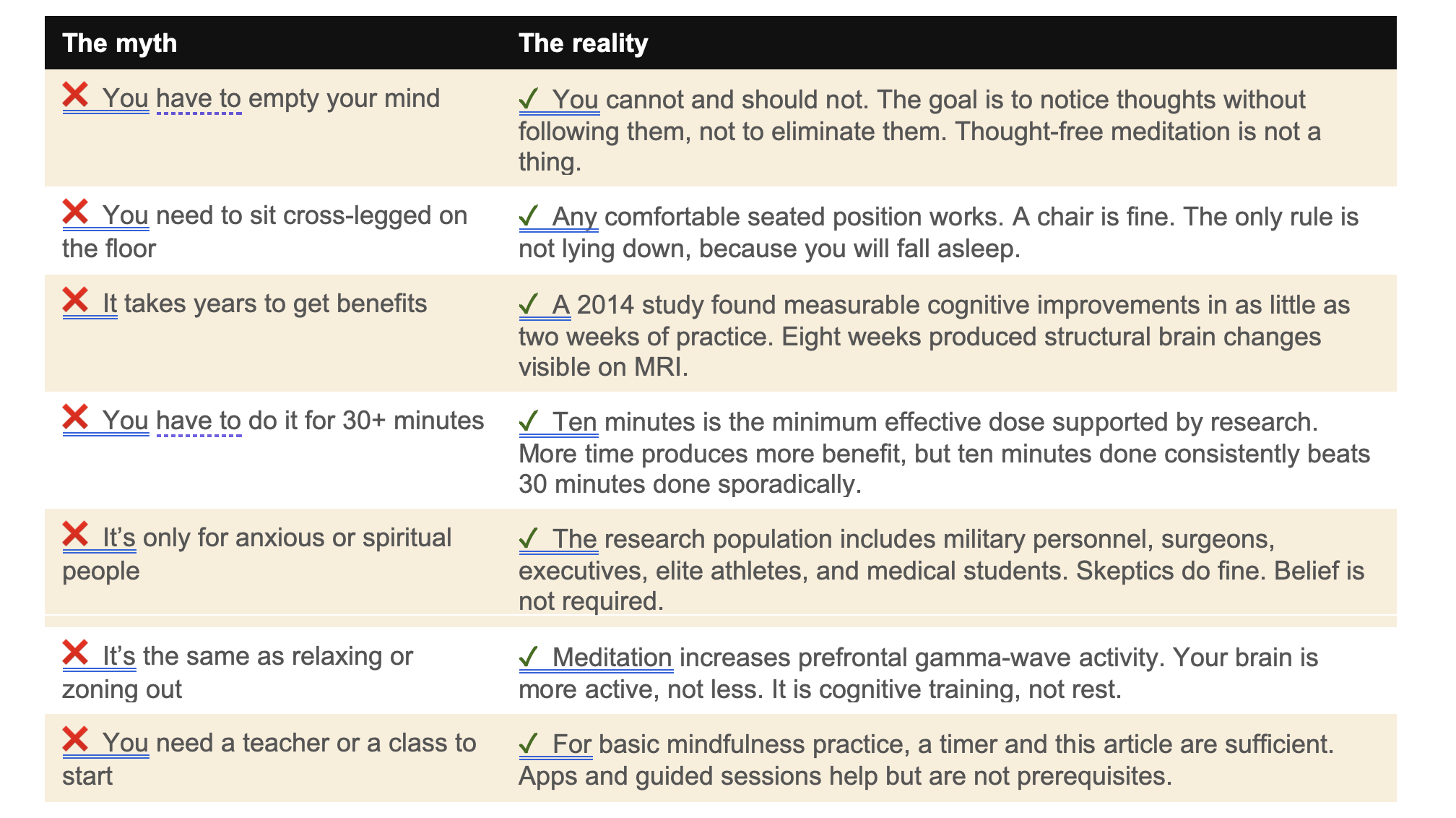
Seven Myths About Meditation Corrected
What the Research Actually Shows: Seven Studies Worth Knowing
The following research is not cherry-picked from fringe journals. These studies are from Harvard, Oxford, Carnegie Mellon, and the University of California, among others. They use neuroimaging, randomized controlled trial designs, and objective outcome measures. The evidence base for mindfulness meditation is now large enough that it would be difficult to dismiss it on methodological grounds.
The Harvard Brain Structure Study
Lazar et al., Harvard Medical School, NeuroReport 2005
Finding: Eight weeks of MBSR (Mindfulness-Based Stress Reduction) produced measurable increases in cortical thickness in the prefrontal cortex and right insula, and a measurable decrease in amygdala grey matter density.
What it means for you: Your brain physically changes structure in eight weeks. The prefrontal cortex thickens (better executive control). The amygdala shrinks (less reactive to stress). You have 96 days left.
The GRE Performance Study
Mrazek et al., Psychological Science 2013
Finding: Two weeks of mindfulness training (10 min/day) significantly improved GRE reading comprehension scores and working memory capacity in college students.
What it means for you: The mechanism is reduced mind-wandering during cognitive tasks. The same attention regulation that improves GRE scores improves your ability to encode new information during study sessions.
The Cortisol Reduction Study
Turakitwanakan et al., Journal of the Medical Association of Thailand 2013
Finding: Even a single 10-minute mindfulness session measurably reduced cortisol and self-reported stress in participants exposed to a social stressor.
What it means for you: One session produces a measurable cortisol drop. In the sustained high-cortisol environment of vet school year one, this is not a minor finding. Daily meditation is the most accessible cortisol management tool available to you.
The Immune Function Study
Davidson et al., Psychosomatic Medicine 2003
Finding: Participants who completed an 8-week MBSR program produced significantly more antibodies in response to an influenza vaccine than controls.
What it means for you: The brain-immune connection is real. Chronic stress suppresses immune function. Meditation attenuates that suppression. You are going to be exposed to an enormous amount during clinical rotations. This matters.
The Medical Student Study
Shapiro et al., Journal of Behavioral Medicine 1998
Finding: Medical students who underwent mindfulness training during a particularly stressful exam period showed significantly less anxiety, depression, and burnout than controls, and better performance on empathy measures.
What it means for you: This is your demographic, your stressors, your timeline. The study was designed for people in your situation. The results held even in the highest-stress periods.
The Sleep Quality Study
Black et al., JAMA Internal Medicine 2015
Finding: Eight weeks of mindfulness practice improved sleep quality, reduced insomnia severity, and decreased nighttime cortisol arousal in adults with sleep disturbances.
What it means for you: Sleep is when memory consolidation happens. If meditation improves sleep quality, it directly improves your brain’s ability to encode what you studied that day. The mechanism connects to your exam performance, not just your wellbeing.
The Hippocampal Volume Study
Holzel et al., NeuroImage 2008
Finding: Long-term meditators had significantly larger hippocampal volume than matched controls. The hippocampus is the primary structure for new memory formation.
What it means for you: This is the long-game argument. Regular meditation literally grows the memory structure of your brain. You are going to be learning new information every day for four years. The investment in your hippocampus is not a soft benefit.
The Neuroscience: What Is Actually Happening During Those 10 Minutes
Understanding the mechanisms makes the practice more credible and makes it easier to maintain when motivation drops. Here is what is happening in your brain during a meditation session.
The default mode network quiets down
The default mode network (DMN) is a set of brain regions that become active during mind-wandering, self-referential thinking, rumination, and unfocused thought. It is the part of your brain that generates thoughts like: “I am so behind,” “I should be studying right now,” “I do not think I am smart enough for this,” and “What was I just reading?” Chronic DMN overactivation is associated with anxiety, depression, and poor academic performance. Meditation systematically reduces DMN activity during both practice sessions and — crucially — during the rest of the day. You get less mind-wandering during your study blocks even when you are not meditating.
The prefrontal cortex strengthens
The prefrontal cortex (PFC) is responsible for attention regulation, working memory, impulse control, decision-making, and the executive management of emotional responses. It is what your brain uses to stay focused on a histology slide instead of checking your phone. Meditation is essentially a repetitive exercise for the PFC — each attention redirect during practice strengthens the neural pathways involved in voluntary attention control. Studies show increased grey matter density and cortical thickness in the PFC after as little as eight weeks of regular practice.
The amygdala gets smaller and less reactive
The amygdala processes emotional responses, particularly fear and threat. In a chronically stressed state — which is what vet school year one produces in most students — the amygdala becomes hyperactive, generating exaggerated stress responses to situations that do not warrant them. Meditation consistently reduces amygdala grey matter volume and functional reactivity. This is not emotional blunting — you still feel things. It is calibration. Your nervous system responds to actual threats rather than perceived ones.
The hippocampus consolidates more effectively
The hippocampus is the primary structure for forming new memories. Cortisol, at chronically elevated levels, is neurotoxic to hippocampal neurons — this is one of the most well-documented mechanisms by which chronic stress impairs learning. Meditation reduces cortisol. Lower cortisol means a healthier hippocampal environment and more effective memory consolidation. This is the direct line between meditation and exam performance that most people do not know about.
Gamma wave activity increases
Experienced meditators show significant increases in prefrontal gamma wave activity during practice. Gamma waves are associated with high-level information processing, cross-modal sensory integration, and heightened attentional states. This is the neurological signature of what meditators describe as heightened clarity or presence. You are not zoning out during meditation. Your brain is in a measurably higher state of integration than its resting baseline.
Meditation reduces default mode network activity, strengthens the prefrontal cortex, shrinks the amygdala, and creates a healthier environment for hippocampal memory consolidation. These are not metaphors. They are structural changes visible on MRI.
Why This Matters Specifically for Vet Students in Year One
The general benefits of meditation are well established. But there are specific reasons why the practice is particularly well-suited to the vet student situation in year one.
THE VET SCHOOL SPECIFIC CASE
You are in a sustained high-cortisol environment. Chronic stress is not just unpleasant. It measurably impairs hippocampal function, reduces working memory capacity, and increases amygdala reactivity. These are the exact cognitive systems you need most during your most demanding academic period. Meditation is one of the few evidence-based interventions that directly counteracts this cascade.
You are learning an enormous volume of new information. Memory consolidation is the rate-limiting step in your academic performance — not how many hours you study, but how effectively your brain encodes what you study. Meditation improves both the quality of attention during learning and the sleep quality during which consolidation happens. Both inputs to the consolidation equation improve simultaneously.
You are managing a grief load that most people outside medicine don’t experience. You are going to witness death, make decisions with consequences you cannot fully control, and form bonds with patients you will lose. Mindfulness practice does not prevent these experiences. It gives you a trained nervous system to metabolize them more effectively rather than accumulating them.
Compassion fatigue is a real occupational risk. Research on healthcare workers specifically shows that mindfulness training reduces compassion fatigue and increases resilience over time. Starting this practice in year one means you are building a foundation during the least clinically intense period of your training, so it is functional by the time you need it most.
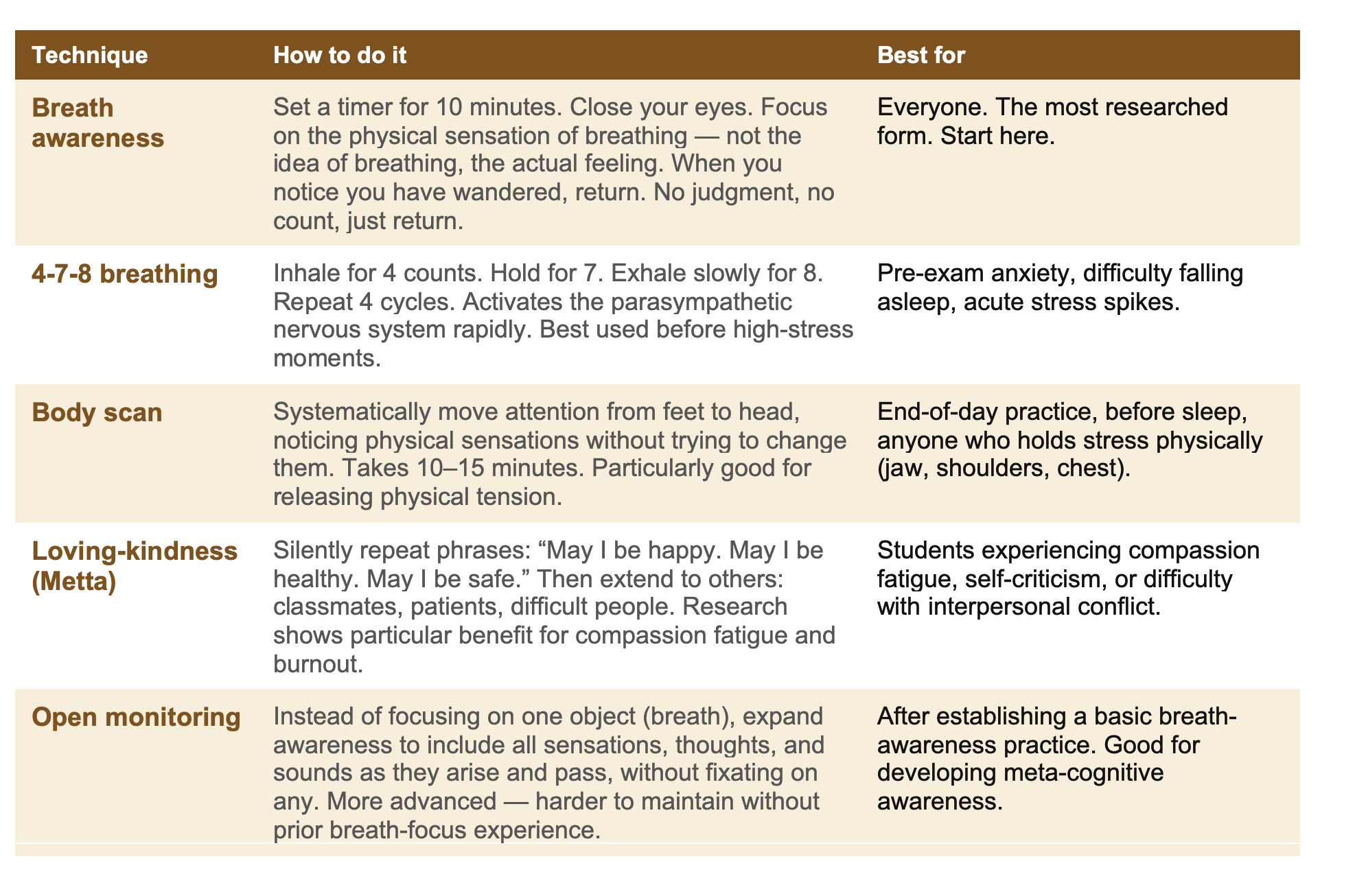
Five Techniques: Find the One That Works for You
Basic breath awareness is the most researched form and the one described above. But there are several other techniques that produce similar benefits and may suit different learning styles and schedules better.
The Protocol: Exactly How to Start Tonight
The biggest barrier to meditation is starting. The second biggest is continuing after the first week when the novelty wears off. The following protocol is designed to minimize both barriers.
WEEK 1: ESTABLISH THE HABIT
When: Same time every day. After your last study block is ideal because meditation functions as both a cortisol reset and a memory consolidation facilitator. Alternatively, first thing in the morning before opening any screens.
Duration: 5 minutes for the first three days, then 10 minutes. Starting shorter reduces the barrier and builds the habit without the psychological weight of a 10-minute commitment from day one.
Where: Seated on a chair or floor with your back reasonably upright. Not lying down. Not in bed. Set the timer before you close your eyes so you are not checking your phone.
What to do: Focus on the breath. When you notice your mind has wandered — and it will, approximately every 30–60 seconds at first — note it neutrally ("thinking") and return to the breath. No frustration. No scoring. Just return.
WEEK 2 AND BEYOND: BUILD THE PRACTICE
Week 2: 10 minutes every day. Track your streak somewhere — a paper calendar, the Insight Timer app’s streak counter, or your Google Calendar. The streak becomes motivational.
Week 3–4: You will begin to notice changes in your normal day. Mind-wandering during study sessions will decrease. Recovery from stressful moments will be faster. These are not placebo effects — they are the functional correlates of the PFC strengthening and the DMN quieting.
Week 8: This is when the Harvard study found structural brain changes visible on MRI. You have been meditating for eight weeks. The amygdala is smaller. The prefrontal cortex is denser. These changes persist after you stop — though regular practice maintains and compounds them.
When You Do Not Want to Do It — Which Is Most of the Time at First
Here is an honest account of what the first two weeks of meditation practice actually feel like for most people. You sit down. Your mind immediately generates a list of everything you should be doing instead. You focus on the breath for approximately four seconds before remembering that you forgot to email your professor. You refocus. You think about whether you left your microscope at the lab. You refocus. You wonder if you are doing this right. You refocus. You check the timer. Three minutes have passed.
This is completely normal. This is what everyone’s first weeks of practice look like, including people who later become consistent long-term meditators. The mind is extraordinarily resistant to being directed, especially when it is operating under the chronic stress of vet school. The initial resistance is not evidence that you are bad at meditation. It is evidence that you need it.
The way through the resistance is not motivation. Motivation is unreliable and will not be there on Thursday nights in week three when you have a practical on Friday morning and you cannot imagine sitting quietly for ten minutes. The way through is structure. The timer goes off. You sit down. You start. The decision is made before you are in the situation where you have to make it.
The resistance you feel in the first two weeks is not evidence that you are bad at meditation. It is evidence that you need it. The practice begins in the moment you sit down anyway.
Free and Low-Cost Resources to Get Started
You do not need to spend money to start a meditation practice. Here are the options, ranked from free to premium.
FREE OPTIONS
Insight Timer: The best free meditation app available. Thousands of guided sessions, a simple interval timer for unguided practice, and a streak tracker. The free version is genuinely complete — you do not need to upgrade.
YouTube: Search “10-minute mindfulness meditation for beginners.” The channel Headspace has a free beginner series on YouTube. Tara Brach and Jon Kabat-Zinn also have extensive free content.
A kitchen timer and this article: Set for 10 minutes. Focus on the breath. Notice the wandering. Return. That is the entire protocol. No app required.
LOW-COST OPTIONS
Headspace: Offers a student discount that brings the annual cost to approximately $7.99/month. The beginner course is particularly well-structured for people who are new to meditation and skeptical about it.
Calm: Similar pricing to Headspace. Known for high production quality and sleep-focused content, which may be particularly useful if sleep quality is an issue.
The Waking Up app: Created by neuroscientist Sam Harris, this app takes a more intellectually rigorous approach to meditation that tends to appeal to skeptics and science-oriented practitioners. Has a scholarship program for those who cannot afford it.
The Argument in Three Sentences
Vet school year one is a sustained neurological stressor that chronically elevates cortisol, suppresses hippocampal function, hyperactivates the amygdala, and depletes the executive resources of the prefrontal cortex. Ten minutes of daily mindfulness meditation is one of the most extensively researched interventions available for reversing each of those effects simultaneously, with measurable structural brain changes appearing in as little as eight weeks. The tool is free, requires no equipment, takes ten minutes, and has a stronger evidence base than most supplements, most productivity systems, and most study strategies you will encounter in year one.
Set a timer tonight. Sit down. Close your eyes. Breathe. Return.
That is the whole thing. The rest is just showing up.
Ten minutes. Ninety-six days left in the Scrub Squad program. If you start tonight and do not skip a single day, you will have your first eight weeks of structural brain changes complete before Day 57. You will have a measurably different brain by the time you sit your first set of board prep exams.
Scrub Squad · Day 3 of 99 · Soul
This article is part of the Scrub Squad 99-day program from Vet Candy. Free for every first-year vet student. Earn your De-Scrub certificate on Day 99.
