

Why 7 Minutes Between Study Blocks Beats a 45-Minute Gym Session Once a Week
Frequency beats duration. Distribution beats volume. Here’s the neuroscience behind why.
At some point in the first month of vet school, you will make a deal with yourself. The deal goes something like this: you are too busy to exercise right now, but once things settle down you will get back to it. Maybe you will find a gym near campus. Maybe you will start running again. Maybe you will do the thing you keep meaning to do.
Things will not settle down. Not in semester one. Not in semester two. Not in year two. The clinical years are not calmer. The expectation that you will have a wide open hour somewhere in your week to dedicate to exercise is going to come into contact with vet school reality and lose badly.
The good news is that the premise of that deal was wrong to begin with. The science does not support the idea that one long weekly workout is the most effective way to get the cognitive benefits of exercise. In fact, for the specific goal of improving memory, focus, and learning performance during a study-intensive period, one long weekly session is one of the least efficient exercise formats you can choose.
What the research actually supports is something that fits inside your Pomodoro break. Seven minutes of movement between study blocks, done consistently across the day, produces cognitive benefits that a single weekly gym session cannot replicate — not because the gym is bad, but because the timing and distribution of exercise matter more than the duration.
The BDNF Problem: Why Timing Is Everything
To understand why frequency beats duration for cognitive performance, you need to understand BDNF. Brain-derived neurotrophic factor is a protein that plays a central role in the formation and consolidation of new memories. It supports the growth of new neurons, strengthens synaptic connections, and is sometimes called “Miracle-Gro for the brain” — a phrase coined by Harvard psychiatrist John Ratey, who has spent decades studying the relationship between exercise and cognition.
BDNF is released during exercise. That is well established. What is less commonly understood is the time course of that release and its functional implications for learning.
BDNF levels spike significantly during moderate-intensity aerobic activity and remain elevated for roughly one to three hours afterward. During that window, the brain is in a state of heightened plasticity — more ready to form new synaptic connections, more capable of encoding new information into long-term memory. This is the window when studying is most productive.
If you exercise at 6am on Saturday morning and then study the rest of your life at your desk, you are not getting that BDNF benefit during your Monday afternoon anatomy review. The benefit is local in time. It applies to what happens in the hours immediately after the exercise, not to the week at large.
BDNF levels spike during exercise and remain elevated for one to three hours. That is the window when studying is most productive. One Saturday workout does not give you that window on Tuesday afternoon.
The Cortisol Problem: What Sustained Studying Does to Your Brain
Here is what happens inside a long uninterrupted study session. For the first 45 to 60 minutes, your cortisol levels are relatively stable and your cognitive performance is reasonably strong. Past that point, sustained cognitive load begins to activate the stress response. Cortisol rises. Norepinephrine, the neurotransmitter associated with alertness and attention, begins to dysregulate. Working memory capacity declines. The rate at which new information encodes into long-term memory slows.
This is the biological reason that studying for four straight hours feels increasingly unproductive. It is not just fatigue. It is a measurable neurochemical shift that impairs the actual encoding of information. You are working harder to learn less.
Movement clears cortisol. Even light to moderate physical activity accelerates the metabolic clearance of cortisol and signals the nervous system that the stressor has passed. A 7-minute movement break between study blocks is not just a rest. It is a cortisol reset that makes the next study block neurochemically closer to the first one than it would be without the break.
This is the mechanism behind the Pomodoro technique’s effectiveness. The break is not a concession to laziness. It is a functional intervention that maintains cognitive performance across a longer study day.
A 7-minute movement break is not just a rest. It is a cortisol reset. It makes the next study block neurochemically closer to your first one than it would be if you had pushed through.
The Memory Consolidation Window You’re Currently Skipping
There is a third mechanism that makes movement between study blocks valuable, and it is one that almost nobody talks about because it is counterintuitive. When you stop actively studying, your brain does not go idle. It enters a consolidation phase in which the information you just processed gets replayed, organized, and transferred toward long-term storage.
This process is called offline consolidation, and it begins within minutes of ending an active learning session. Research from the University of Edinburgh found that even a brief 10-minute rest with minimal external stimulation significantly improved memory retention compared to immediately continuing with new material. The brain needs the processing time. When you give it movement instead of more input, you get both the consolidation benefit and the BDNF benefit simultaneously.
The reason most students never experience this is that they treat study breaks as opportunities to consume something else — social media, YouTube, a conversation, a podcast. All of those activities compete directly with the consolidation process because they introduce new information that the brain has to process instead of reprocessing what it just learned. The most cognitively productive break is one that involves movement and minimal information input. Walking without headphones. Light movement in your room. Seven minutes of something physical with nothing competing for your auditory attention. The most cognitively productive break involves movement and minimal information input. Walking without headphones. Light movement, no podcast. Your brain is doing real work in that window — let it.
7 vs. 45: The Direct Comparison
Here is what the research actually shows when you compare distributed micro-exercise across a study day against a single concentrated weekly session, specifically for cognitive and academic performance outcomes.
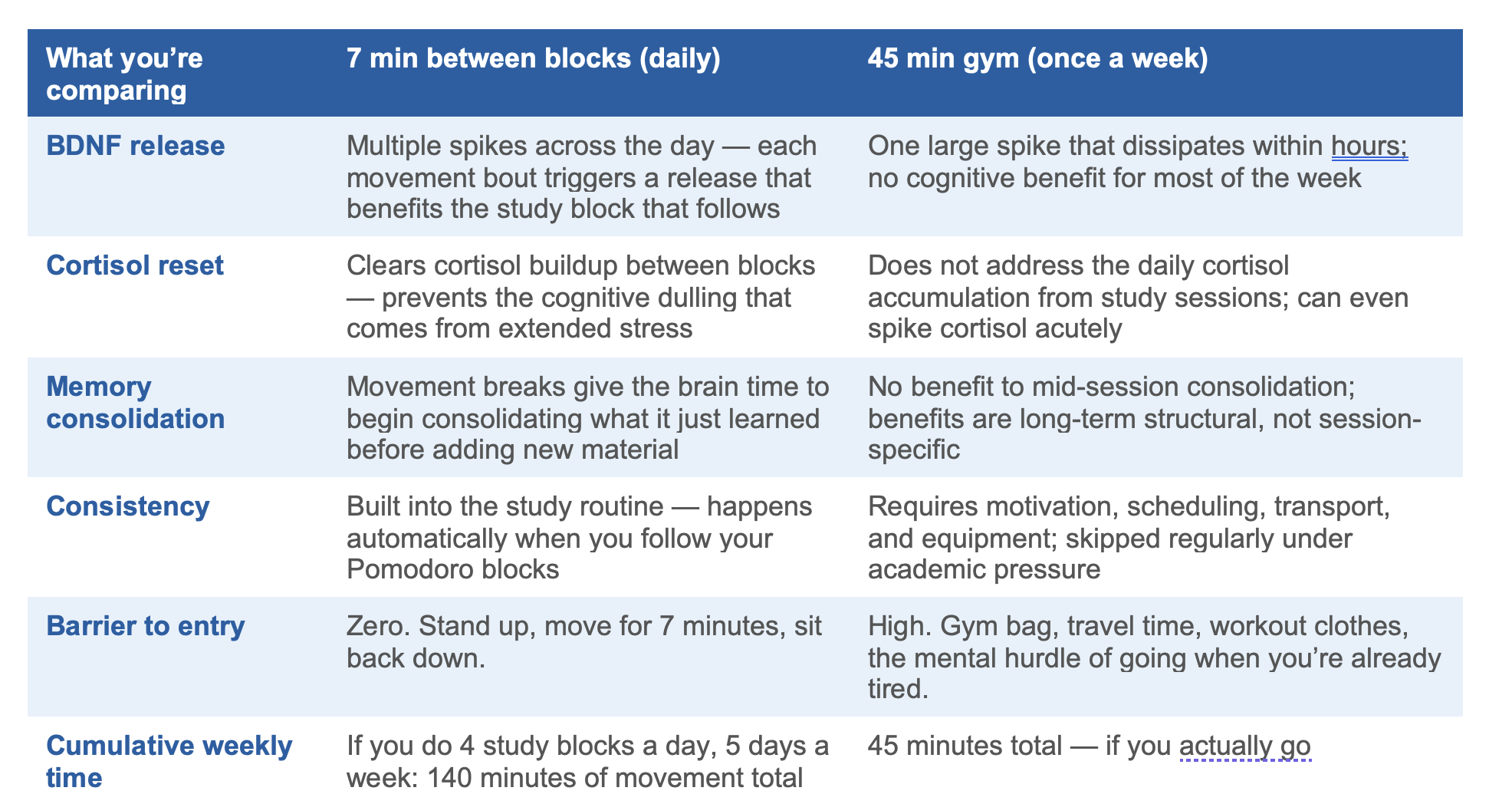
The weekly gym session is not without value. Long-form aerobic exercise produces structural brain changes over time — increased hippocampal volume, improved vascular health, better sleep architecture — that support learning over months and years. If you can maintain a consistent gym routine through vet school, it is worth keeping. The point is not that the gym is bad. The point is that micro-movement between study blocks produces specific cognitive benefits that the weekly session cannot provide, and that for most vet students in year one, micro-movement is the realistic option.
The 7-Minute Protocol
Here is exactly what to do in the 7-minute break between Pomodoro blocks. This is not a workout. It is a neurological maintenance procedure. No equipment. No gym clothes. No commute. No motivation required beyond standing up when the timer goes off. The timer going off is the only trigger you need.
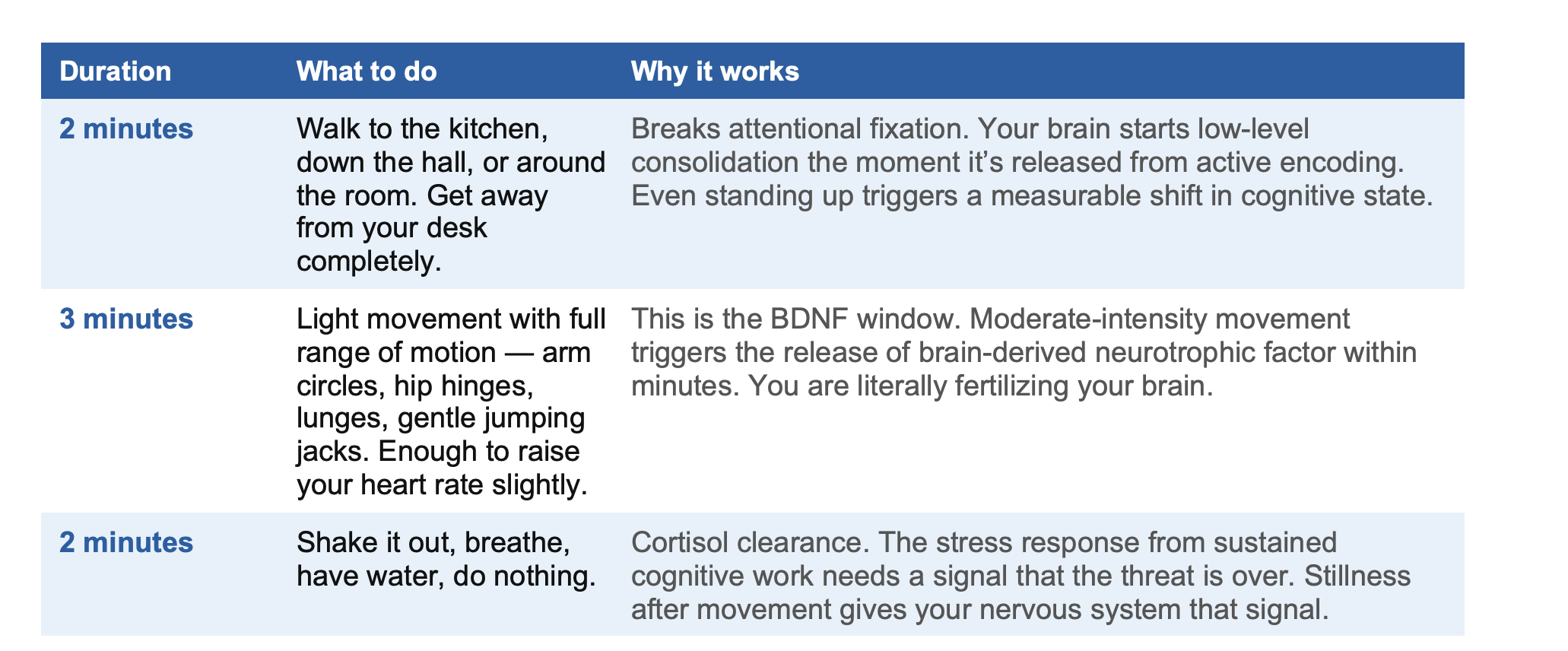
What to Actually Do: Seven-Minute Options by Space
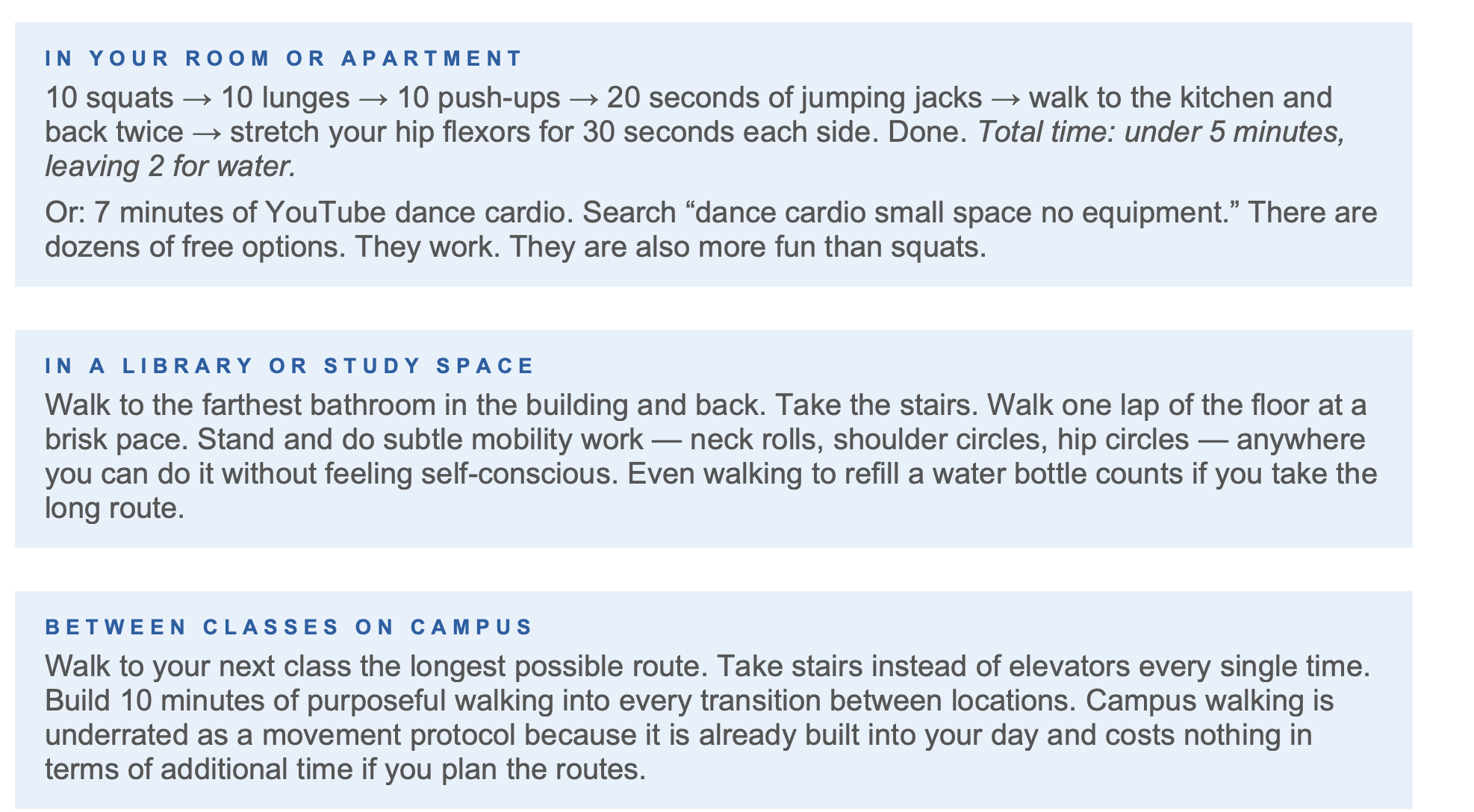
The most common reason students skip movement breaks is not laziness. It is not knowing what to do in a small space with no equipment and limited time. Here are specific options organized by where you are.
IN YOUR ROOM OR APARTMENT
The Compounding Effect: Why This Gets Better Over Time
The benefits of consistent micro-movement between study blocks are not static. They compound. Here is what the research shows happens when students maintain this pattern across a semester rather than doing it sporadically.
After two to three weeks of consistent practice, the movement breaks become easier to execute because they are habitual. The decision fatigue of choosing whether to take a break disappears because the break is automated into the study block structure. Students who build this into their Pomodoro routine report that skipping the break starts to feel uncomfortable — the opposite of what most people expect.
After four to six weeks, baseline BDNF levels begin to rise. This is not just a session-by-session effect. Regular exercise, even in the form of distributed micro-sessions, produces sustained upregulation of BDNF production. The brain gets better at forming new memories over time, not just in the hours immediately following each movement bout.
After a full semester, students who maintained consistent movement breaks show better performance on cumulative assessments than those who did not, even when controlling for total study hours. The difference is not in how much they studied. It is in how efficiently their brains encoded what they studied.
Regular micro-exercise produces sustained upregulation of BDNF production over weeks. The brain gets better at forming new memories over time, not just in the hours after each session. This is a long game worth playing from day one.
The One Change to Make Today
Set your study timer for 45 minutes. When it goes off, stand up. Move for 7 minutes. Come back to your desk. That is the entire protocol.
You do not need to decide right now whether you are going to maintain a gym habit through vet school. That is a longer conversation. What you can decide right now is that when your Pomodoro timer goes off, you will stand up instead of immediately reaching for your phone.
The phone is the enemy of the consolidation window. The 7-minute movement break is the mechanism. The BDNF spike is the reward. The better exam performance is the downstream consequence.
Start today. Not when things settle down. Things are not going to settle down. But your study blocks can be smarter than they were yesterday, starting with the next one.
Scrub Squad · Day 3 of 99 · Body
This article is part of the Scrub Squad 99-day program from Vet Candy. Free for every first-year vet student. Earn your De-Scrub certificate on Day 99.
