

Kayli Woodward Spent Her Summer Hunting for a Biomarker That Could Change Horse Racing
A second-year Texas A&M vet student with almost no research background spent her summer chasing a drug-testing breakthrough for equine sports, and came out of it seeing veterinary medicine differently.
For Kayli Woodward, a second-year veterinary student from Frisco, Texas, walking into a research lab for the first time felt like foreign territory. She had almost no research experience going in. That was kind of the point.
Woodward applied to Texas A&M's Veterinary Medical Scientist Research Training Program, a summer program that pairs DVM students with faculty mentors for hands-on research, specifically because it would push her somewhere unfamiliar.
“I wanted to spend my summer doing something that would push me outside my comfort zone and widen my knowledge base,” Woodward said. With an eye on specializing after graduation, she saw the program, mentorship plus the chance to present findings at a national symposium, as a head start on whatever research demands her future specialty might bring.
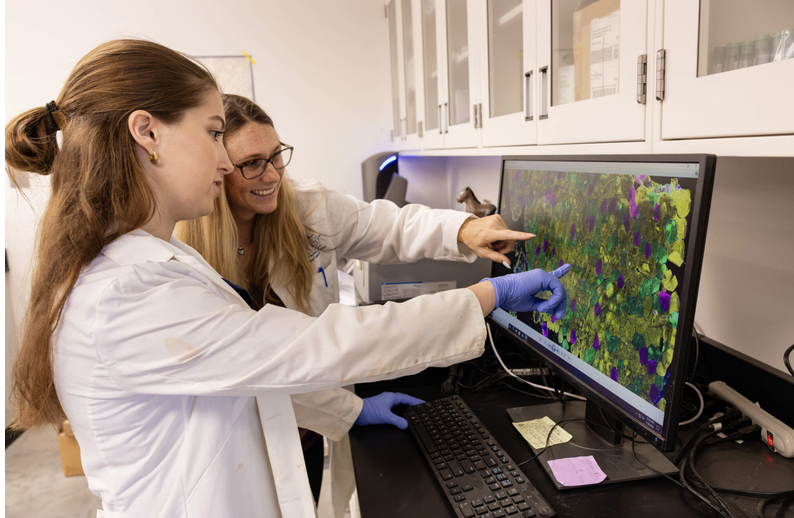
Credit: Hannah Treider ’26, VMBS Marketing & Communications
The program let her choose her own mentor, and she picked someone familiar: Sarah White-Springer, Ph.D., the Link Endowed Chair in Equine Science and associate professor of equine physiology in the Department of Animal Science, who had taught one of Woodward's undergraduate classes. Woodward, who earned her bachelor's degree in animal science with an equine science certificate in 2025, wanted to see the field she'd studied from a research angle instead of a classroom one.
Together, she and White-Springer spent the summer studying chronic use of β-2 agonists in horses, drugs primarily prescribed as bronchodilators but also used off-label as performance enhancers because of how they affect muscle composition. The team is after a biomarker that could flag long-term use of newer β-2 agonists, the kind of finding that could eventually sharpen drug-testing protocols and help protect horses competing in equine sports.
“What makes this experience so rewarding was seeing our hard work materialize into real data,” Woodward said, adding that being part of a project aimed at preventing harm to the animals themselves gave the work a purpose that went beyond the lab bench.
The research process itself reshaped how Woodward thinks. Answers didn't arrive on schedule, and she had to get comfortable sitting with uncertainty, working through possibilities, and trying again when an approach didn't pan out. White-Springer pushed her through that discomfort rather than around it, asking hard questions and expecting Woodward to know the full weight of what she was presenting.
“Dr. White taught me how to pivot, analyze the variables and potential hiccups, and work out a new approach without getting discouraged,” Woodward said. “It made me much more confident in the science that I am learning.”
That confidence came with a broader shift in perspective. Spending a summer designing a study, testing a hypothesis, and analyzing data gave Woodward a new appreciation for how much work sits underneath what students often treat as settled, standard knowledge, and for the decades of research that built the field she's now entering.
She's carrying that lens forward into a planned career in equine medicine, with a specific hope for where her summer's work leads.
“I am especially hopeful that our research paves the way for a new drug test that can detect novel β-2 agonist use,” Woodward said.
ABOUT THE PROGRAM
What: the Veterinary Medical Scientist Research Training Program (VMSRTP), a summer research program for DVM students.
Host: Texas A&M College of Veterinary Medicine and Biomedical Sciences.
Format: students choose a faculty mentor and work on a hands-on research project, then present findings at a national symposium.
Source: Story by Haley Roedder, originally published by the Texas A&M College of Veterinary Medicine and Biomedical Sciences. Photos by Hannah Treider '26, VMBS Marketing & Communications.
Share This Article
Free Membership
Enjoyed this article?
There's a lot more where that came from.
Join 50,000+ veterinary professionals who get free RACE-approved CE, weekly clinical updates, and the most talked-about veterinary magazine in the profession — all completely free.
Join Vet Candy Free →No credit card. No catch. Just everything veterinary.