

Green Paw Certification Wants to Make Sustainability Actually Doable for Vet Clinics
The Veterinary Sustainability Alliance's new certification breaks clinic sustainability into 10 achievable actions, backed by nearly 200 evidence-based recommendations. One Toronto clinic already has the sticker to prove it.
When the Veterinary Sustainability Alliance launched its new website and Green Paw Certification program on December 1, veterinarian Matthew Richardson had a slow week on the schedule and two hours to spare. He pulled together his clinic's documentation and hit submit, making The Animal Clinic in Toronto the first veterinary practice in North America to earn the certification.
“It is lonely being the only one,” Richardson wrote afterward, encouraging other clinics to catch up. That's the gap Green Paw is built to close: a clear, structured, genuinely achievable path into sustainability for clinics that have no idea where to start, and a way for clinics already doing the work to get recognized for it.
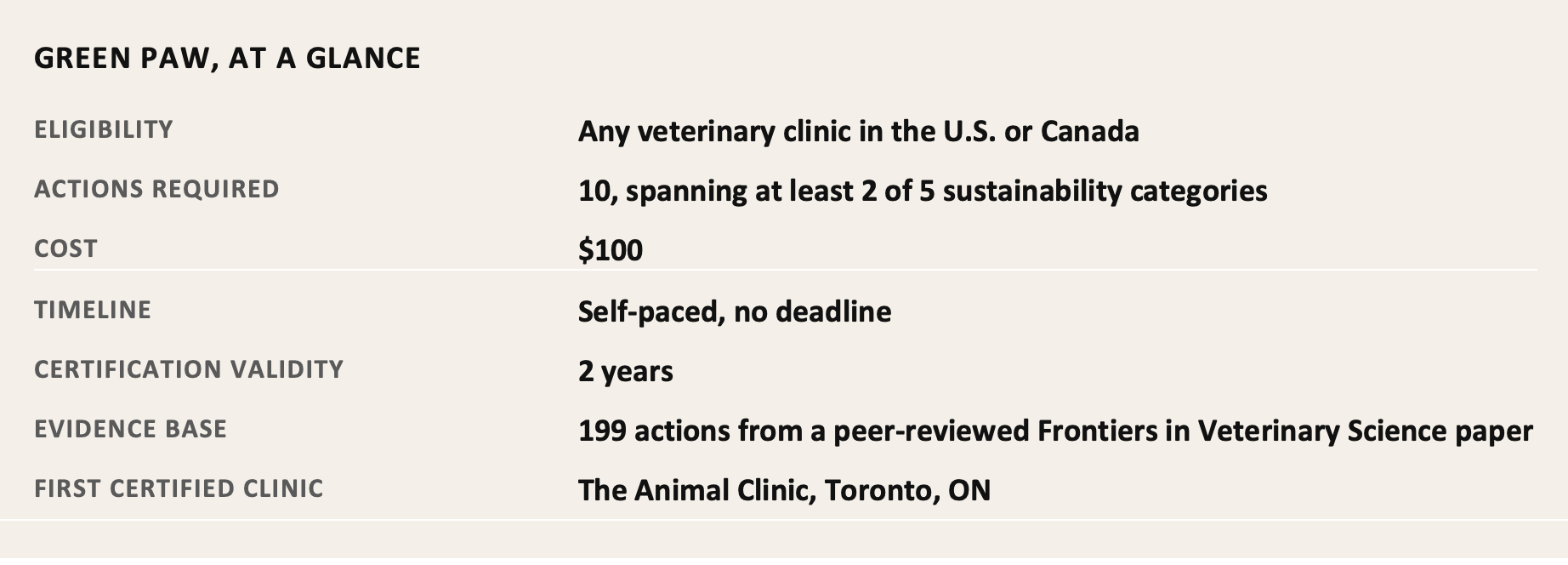
Green Paw is VSA's first clinic certification, and it's designed to be an entry point, not a hurdle. Any veterinary clinic in the United States or Canada can participate, regardless of size, species focus, or budget. Clinics move through the requirements at their own pace, with no deadline, and the process is meant to work whether a practice is starting from zero or already halfway there.
The program is built around 10 actions, organized loosely around VSA's “Nautilus” framework of Core, Clinic, and Community. It starts with forming a Green Team, a mix of vets, technicians, and client-facing and management staff, and completing VSA's short course on the Pathway to a More Sustainable Clinic. From there, clinics assess their current environmental footprint to establish a baseline, then choose five sustainability actions spanning at least two of five categories: energy, waste, water, procurement, and transportation. After implementing those five actions, clinics share what they did internally and externally, and wrap up by staying connected to the wider VSA community. Once all 10 actions are documented and submitted together, along with a $100 fee, VSA reviews the materials and issues the certification, a digital badge, and a window decal. It's valid for two years.
The actions themselves don't have to be dramatic. Richardson's own list at The Animal Clinic ranged from small (TerraCycle boxes for hard-to-recycle items, swapping bottled water and single-use coffee pods for filtered water and whole bean coffee, reusable rags and dishware) to medium (bicycle delivery for client medications, smart thermostats, supporting staff who commute by bike, even through a Canadian winter) to large (a full LED lighting retrofit). The point isn't to overhaul a practice overnight. It's to pick changes that fit the clinic and actually get them done.
That flexibility isn't accidental. Green Paw is grounded in a peer-reviewed paper, Environmental Sustainability in Veterinary Clinics: Best Practices for the United States and Canada, published in Frontiers in Veterinary Science. The research, led by Colorado State University ACVPM residents Caroline Kern-Allely and Danni Scott alongside Katie Clow at the University of Guelph and Colleen Duncan, combined a gray literature review with a structured expert panel to score nearly 200 possible clinic actions on both environmental impact and effort required to implement them.
“The Frontiers paper provides the evidence. Green Paw provides the structure,” Duncan wrote of the relationship between the two. Clinics that want the full menu of options rather than just the ten required actions can pull from a free downloadable list drawn directly from the paper's nearly 200 recommendations.
For clinics and hospitals weighing whether it's worth the time, VSA and its supporters point to more than the environmental case. A completed Green Paw certification gives a team a shared project to be proud of, something concrete tied to protecting the planet rather than another policy memo. It's increasingly framed as a recruitment and retention tool too, particularly for new-graduate veterinarians and technicians who weigh a practice's values as part of where they choose to work. And because Green Paw is explicitly positioned as the first in a planned series of tiered VSA certifications, clinics that complete it now are laying groundwork for whatever comes next, rather than starting over later.
Academic veterinary hospitals are eligible too, though given their size, VSA asks that certification happen at the level of an administrative unit or service, so the whole team involved can meaningfully take part in all 10 actions.
Clinics ready to start can find the full action forms, a discovery guide, and the downloadable list of nearly 200 sustainability ideas on VSA's Clinic Certification page.
Source: Veterinary Sustainability Alliance, including blog posts by Matthew Richardson and Dr. Colleen Duncan, and Kern-Allely et al., “Environmental Sustainability in Veterinary Clinics: Best Practices for the United States and Canada,” Frontiers in Veterinary Science (2025).
Share This Article
Free Membership
Enjoyed this article?
There's a lot more where that came from.
Join 50,000+ veterinary professionals who get free RACE-approved CE, weekly clinical updates, and the most talked-about veterinary magazine in the profession — all completely free.
Join Vet Candy Free →No credit card. No catch. Just everything veterinary.