

How One Chicken, One Bag of Bones, and a Little Planning Feed a Brain-Healthy Diet for $500 a Month
There is a particular kind of kitchen alchemy that happens when nothing gets thrown away: a roast chicken becomes dinner, then lunch, then the broth for Thursday's ramen. A single Sunday afternoon becomes a month of breakfasts. What follows is not a diet plan so much as a system, one built on a $500 monthly grocery budget, a single person's appetite, and the stubborn belief that homemade is both cheaper and better.
The Math Behind the Menu
Every dollar in this plan is doing double or triple duty. The strategy rests on three simple habits, repeated all month until they become second nature. First, almost everything is made from scratch rather than bought pre-made — waffles from flour and baking powder instead of a box mix, pizza dough and sauce built from pantry staples, teriyaki sauce whisked together from soy sauce, honey, garlic, and ginger, and bone broth simmered in a slow cooker from saved bones instead of poured from a $4-to-$6 carton.
Second, one big protein purchase is stretched to its very last bite. Two whole chickens, bought at the start of the month, do the heaviest lifting: roast dinners, shredded-chicken lunches, a pot of ramen, and, once the meat is gone, a batch of bone broth from the bones. Nothing leaves the kitchen except bones and truly inedible scraps, and even the bones become dinner again.
Third, staples are bought once, in bulk, while perishables are restocked weekly. Oats, rice, quinoa, flour, nuts, and canned goods arrive in large, cost-per-ounce-friendly sizes at the start of the month. Spinach, bananas, and yogurt, by contrast, are picked up in smaller weekly runs, just enough to use before they spoil. Think of it like this, two whole chickens, bought at the start of the month, produce four-plus dinners, four-plus lunches, and two full batches of bone broth. Nothing but bones and truly inedible scraps ever leaves the kitchen.
Shopping Smart, Store by Store
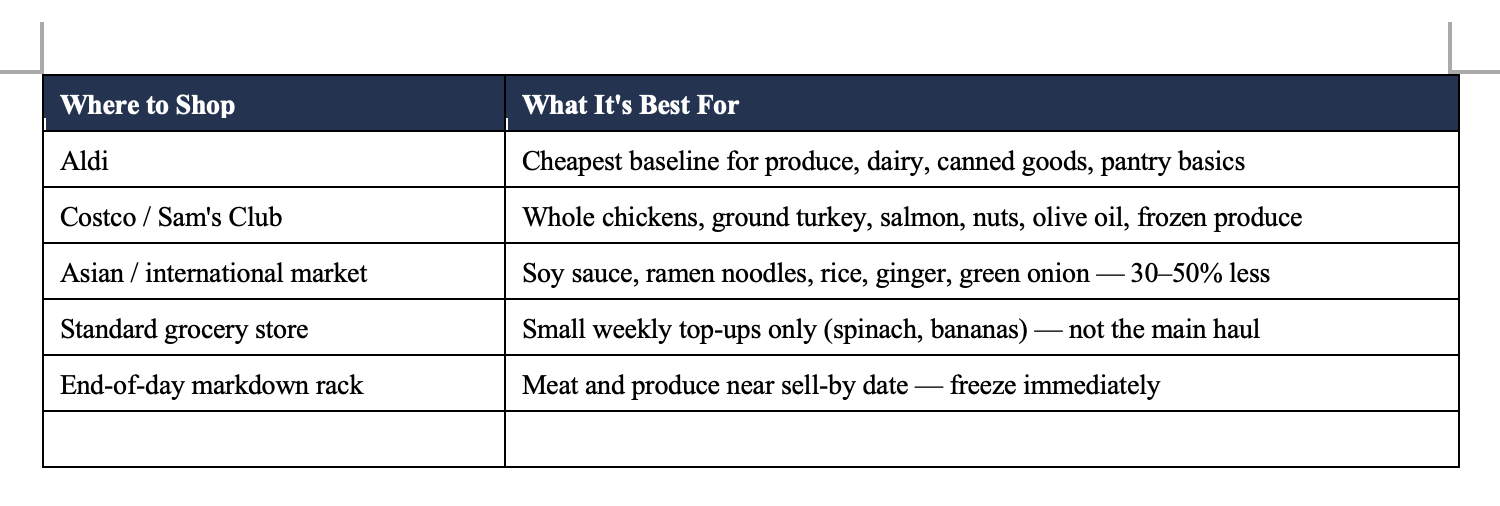
Part of the savings comes from refusing to buy everything in one place. A standard grocery store, this plan argues, should be reserved for small perishable top-ups only — treating it as the main source for a month of groceries is, in its words, the single biggest budget-buster. Instead, the heavy lifting is split across a few specialty stops:
The underlying rule for any bulk purchase is to compare unit price rather than sticker price, and to only buy bulk on things that will actually get finished, grains, nuts, flour, frozen protein, canned beans, never delicate greens or fresh herbs. Bulk meat gets portioned and frozen the moment it comes home, so nothing suffers freezer burn waiting its turn. Consider checking marketplace ads for a used but functional freezer to have more space for cold storage.
The Sunday Ritual That Makes the Week Run Itself
The entire system depends on front-loading effort into one or two longer sessions, a free evening, a Sunday afternoon, so that weekday breakfasts, lunches, and even most dinners take minutes rather than an hour of after-class cooking. The guiding rule is simple: whenever a recipe is already out and the oven or stovetop is already running, double or triple the batch and freeze the extra. The active time barely changes, but it buys back several days later.
A typical prep session, roughly ninety minutes long, unfolds in layers. The grains — rice or quinoa — go on first, needing no attention once they're started. While they cook, that week's dough or waffle batter gets mixed and portioned. The week's chicken goes into the oven to roast, its bones set aside for broth the moment the meat is off. Energy bites or baked oatmeal cups get made while the oven is already hot for something else. Everything is labeled and frozen in the portion it will actually be eaten in — a food-safe marker and a roll of tape doing more to prevent waste than any amount of willpower.
Waffles: One Session, a Month of Breakfasts
A full batch which is about sixteen waffles, comes together in thirty to forty minutes, most of it hands-off while the iron does the work. The key step is patience: cooling them completely on a rack before freezing prevents both sogginess and freezer burn, and freezing them in a single layer before bagging keeps them from fusing into one solid block. From frozen, they go straight into the toaster for two to three minutes, no thawing, no advance planning, even on the most rushed morning. Top them with a nut butter for more protein. Add oats to the mix for more fiber.
Pizza Dough: Make Once, Bake When Needed
Doubling or tripling a dough recipe costs only a few extra minutes of kneading. After the first rise, the dough is divided into individual pizza-sized balls, lightly oiled, and frozen separately — which is what turns “pizza night” into a twice-a-week event rather than a from-scratch project each time. A dough ball moved from freezer to fridge the morning of (or the night before) is ready to stretch by dinner; in a pinch, it will also thaw at room temperature in two to three hours.
Bone Broth: Set It and Forget It
Broth starts with a slow cooker (you can get these very cheap on Marketplace) on low and then needs nothing from anyone for twelve to twenty-four hours. Once strained and cooled, it's portioned into one- or two-cup freezer containers, so a ramen bowl or a pot of soup never requires thawing more than what's needed.
Grains, Sauces, and Desserts: Cook Once, Eat All Week
A full week of brown rice or quinoa is cooked in one pot on prep day and reheats in under two minutes for any bowl. Teriyaki sauce, doubled whenever it's made, keeps for two weeks refrigerated, skipping a step entirely on noodle night. Energy bites and baked oatmeal cups both hold for one to two weeks, refrigerated or frozen, so a single batch made every other week is enough.
Two Purchases, Used Until They're Gone
If the whole plan has a hero ingredient, it's the whole chicken, or rather, two of them, bought at roughly eleven pounds for about nineteen dollars. Chicken #1 is roasted on day one for dinner, then shredded for the next day's lunch salad, then folded into Thursday's ramen. Its carcass, skin, and bones go straight into a freezer bag and become a batch of bone broth, which in turn feeds both the ramen and Saturday's turkey and vegetable soup. Chicken #2 repeats the cycle a week later. The arithmetic is the whole point: two chickens yield four-plus dinners, four-plus lunches, and two full batches of broth, with nothing wasted but bones, and even those become dinner again.
The second workhorse is five pounds of ground turkey, bought once and portioned immediately into one-pound freezer bags so only what's needed ever thaws. Across the week it turns up as a pizza topping on Tuesday, a teriyaki noodle bowl on Wednesday, and the base of Saturday's soup — stretching a single purchase across all four weeks of the month.
You can substitute tofu for meat if you want to stay meatless.
A Pantry of Homemade Staples
Rather than reaching for boxed mixes or bottled sauces, this plan builds its own versions of everything from scratch, at a fraction of the store-bought cost:
• Frozen waffles — whole wheat flour, baking powder, honey, eggs, milk, and oil, frozen flat and toasted straight from the freezer.
• Bone broth — chicken carcass, saved vegetable scraps, a bay leaf, peppercorns, and a splash of apple cider vinegar, simmered twelve to twenty-four hours.
• Chicken bone broth ramen — homemade broth, noodles, shredded chicken, a soft-boiled egg, mushrooms, spinach, and green onion, with a spoonful of miso stirred in at the end for depth.
• Whole wheat pizza — a simple flour-yeast-water dough and a sauce of canned crushed tomatoes simmered with garlic and oregano, topped with mozzarella, turkey, and whatever vegetables need using up.
• Teriyaki turkey noodle bowls — a homemade copycat sauce of soy sauce, honey, garlic, and ginger, tossed with browned turkey, steamed vegetables, and noodles or rice.
• Rotating desserts — energy bites, baked oatmeal cups, chia pudding, yogurt bark, and banana “nice cream,” all built from ingredients already in the kitchen.
Built for a Busy, Portable Life
Several breakfasts and lunches in this plan are, in effect, smoothies and grain bowls in disguise — formulas flexible enough to swap in whenever the schedule gets tight. The go-to smoothie combines milk or water with Greek yogurt, banana and frozen blueberries, and a boost of nut butter, chia seeds, and a handful of spinach that disappears once blended — ready in under three minutes with no dishes beyond the blender. The go-to grain bowl pairs a cup of already-cooked rice or quinoa with beans or shredded chicken, a handful of greens, and a drizzle of olive oil and lemon or leftover teriyaki sauce; more than a dozen days on the calendar already follow exactly this formula.
The same logic makes the plan easy to adapt to a dorm room or a small apartment kitchen. The minimum equipment is modest — a blender, a rice cooker or single pot, a slow cooker for broth, and oven or toaster-oven access for roast chicken and pizza night. Without an oven, a store rotisserie chicken stands in for the roast (its carcass still makes broth), and pizza night becomes a stovetop flatbread instead. The batch-cooking rhythm stays the same: one weekend session for grains, waffles, and energy bites turns weekday breakfasts and lunches into five-minute affairs, and smoothies and grain bowls — needing no stovetop at all — travel well between a dorm and the library during exam week.
One Week, on Repeat — With a Clean-Out Finale
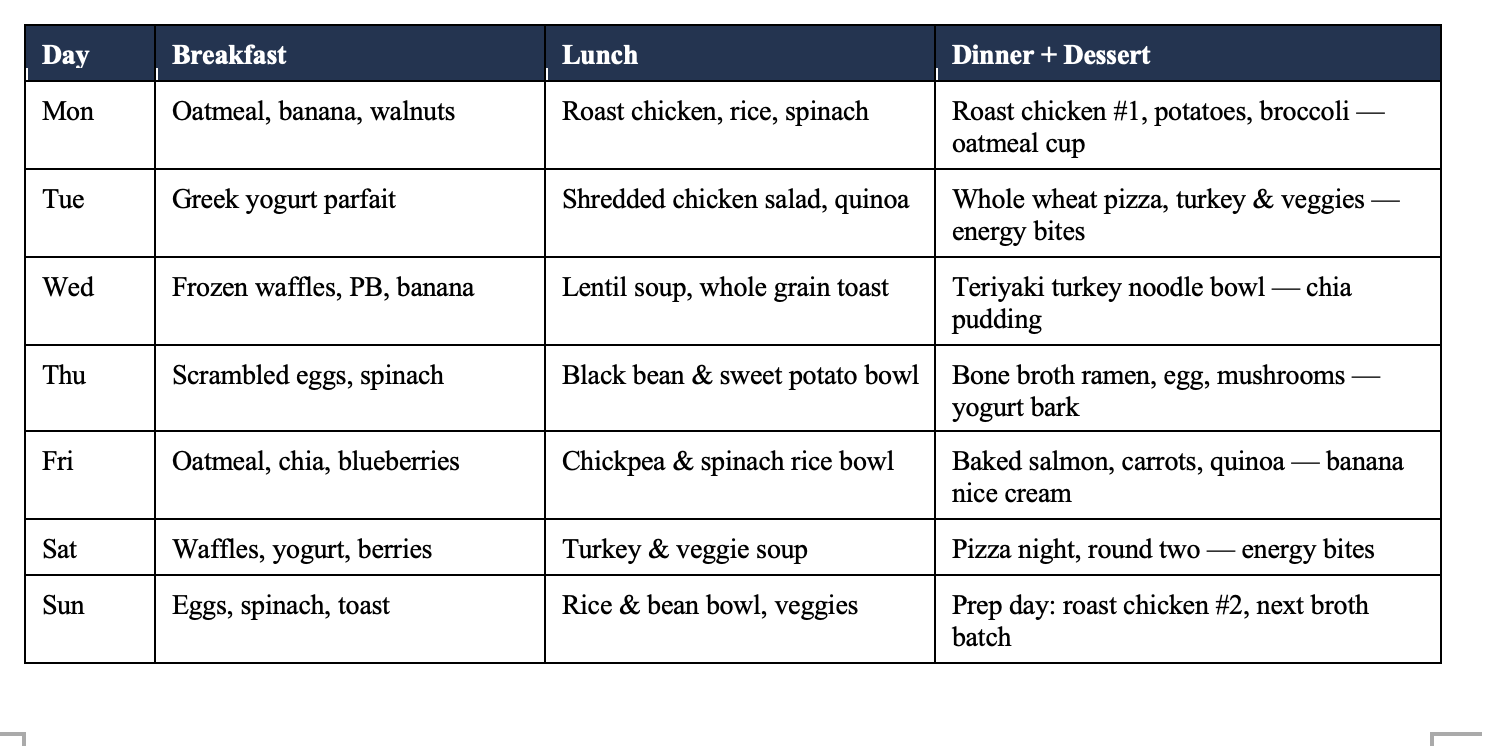
The same seven-day rotation repeats across all four weeks of the month, which is precisely what makes the batch-cooking system work: each week's prep — broth, dough, waffles, energy bites — feeds directly into the next. A single week captures the whole rhythm:
The Ledger: What $500 Actually Buys
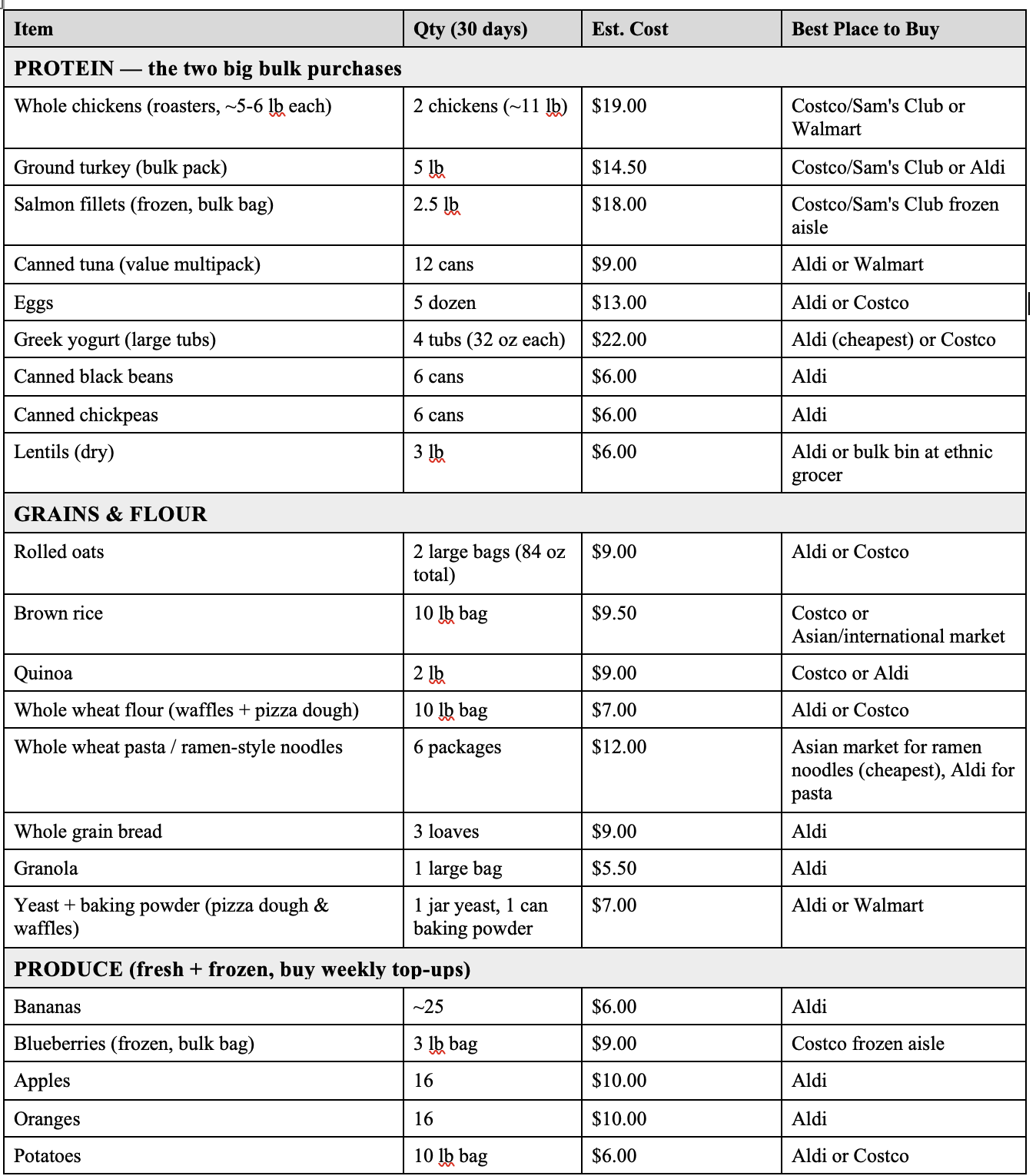
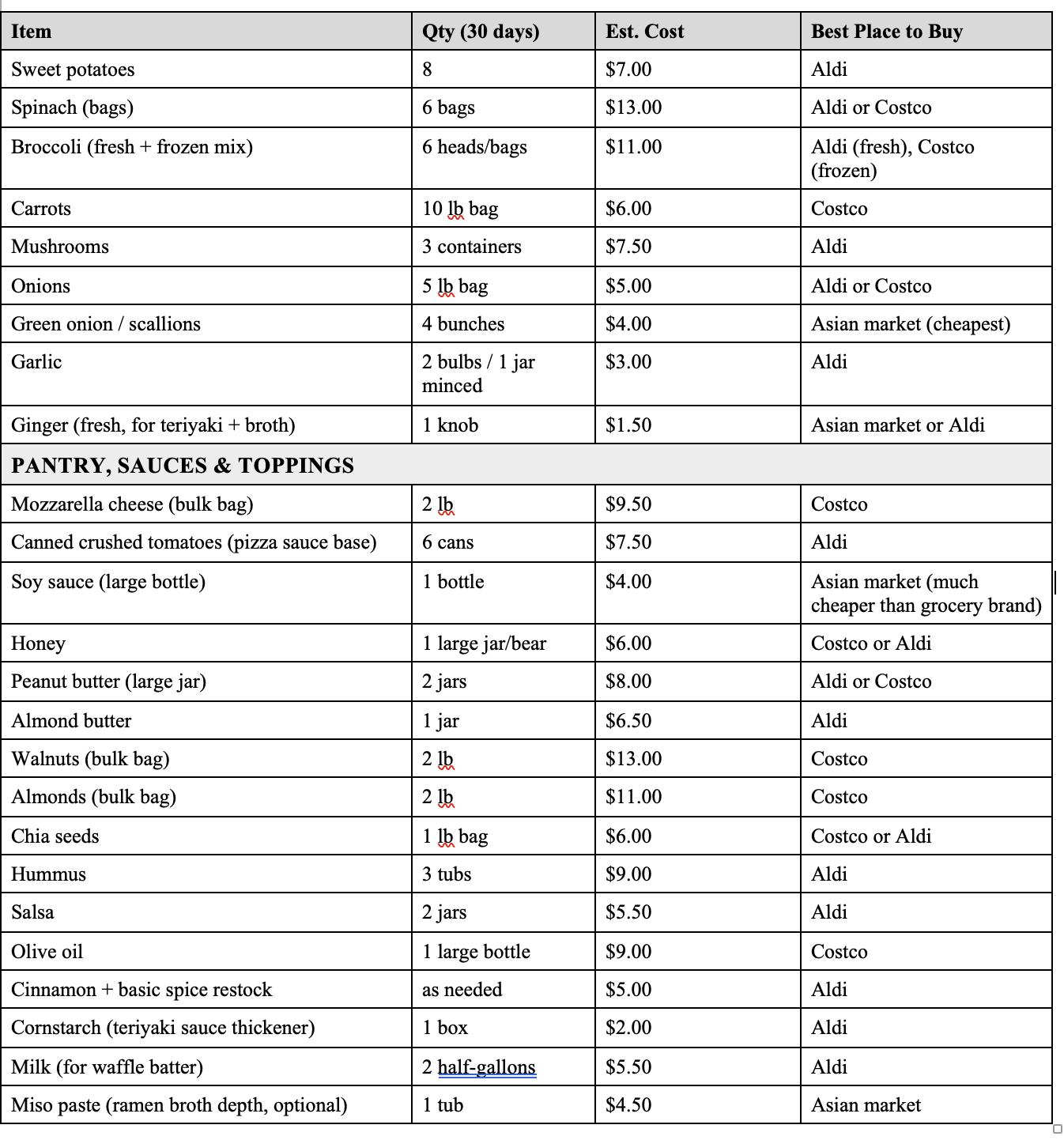
The full month's grocery list runs to roughly sixty items across protein, grains, produce, and pantry staples — two whole chickens and five pounds of ground turkey anchoring the protein list; oats, brown rice, quinoa, and whole wheat flour anchoring the pantry; and weekly top-ups of spinach, bananas, and yogurt keeping the produce drawer honest. Tallied up, the plan lands at an estimated $488 to $495, leaving a small five-to-twelve-dollar buffer for regional price differences. If local prices run higher, the plan's own advice is to trim the priciest per-pound items first — swapping some fresh salmon for canned, or scaling nuts back to a pound each and leaning more on chia seeds and peanut butter.
Why It's Good for the Brain, Too
The ingredient list wasn't chosen for cost alone. Oats, brown rice, quinoa, and whole wheat flour provide steady glucose for the brain and fiber for gut-brain health; salmon and bone broth supply omega-3s and the collagen and gelatin that support both brain and gut lining. Eggs, Greek yogurt, chicken, and turkey bring protein and choline for neurotransmitter production, while blueberries, oranges, and apples contribute antioxidants linked to cognitive protection. Leafy greens and mushrooms add folate, vitamin K, and B vitamins; walnuts, almonds, and chia seeds deliver vitamin E and healthy fats for brain cell membranes; and lentils, beans, and chickpeas round it out with fiber and plant protein for steady, sustained energy.
In the end, the plan's real innovation may not be any single recipe but the discipline of the system itself: buy deliberately, cook once, waste nothing, and let a single Sunday afternoon carry an entire month.
