

Vet School Is Hard Enough. Feeding Yourself Shouldn’t Be.
There are a lot of things veterinary students openly talk about: exams, anatomy labs, sleepless nights, crushing schedules, and imposter syndrome. But there’s one struggle that often stays hidden: not having enough food. Food insecurity doesn’t always look dramatic. Sometimes it’s skipping lunch because there’s nothing packed, stretching what’s left in the refrigerator until the next paycheck or loan disbursement, or deciding that coffee counts as breakfast because groceries have become one more expense competing with tuition, rent, textbooks, transportation, and everything else it costs to become a veterinarian.
Even when there is enough money for groceries, veterinary students face another problem: time. After a full day of lectures, labs, studying, meetings, and trying to maintain some semblance of a life outside of school, preparing an elaborate dinner is probably not happening. That’s exactly why Vet Candy decided to create something practical: a cookbook made specifically for veterinary students.
Meet Vet Candy’s New Cookbook for Veterinary Students
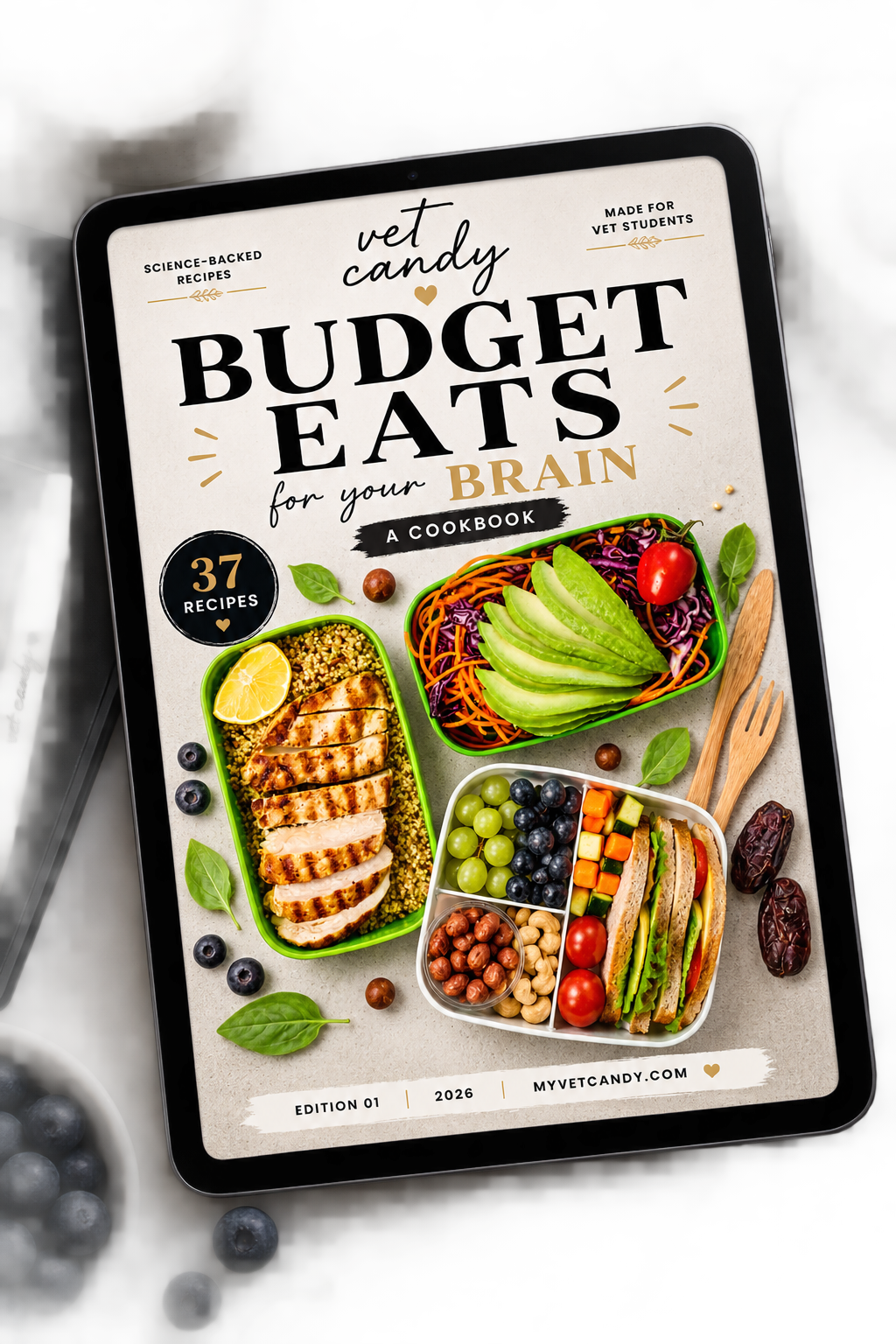
Vet Candy’s new cookbook isn’t filled with aspirational recipes requiring 19 ingredients, three pans, and some obscure spice you’ll buy once and discover in the back of your cabinet when you graduate. It was designed around a much more realistic philosophy: eat well, spend less, waste almost nothing, and make cooking fit into your life instead of taking it over.
The cookbook grew out of a budget-friendly system designed around approximately $500 in groceries for one person for an entire month. Instead of relying heavily on prepared foods, the plan uses inexpensive staples, strategic bulk purchases, simple homemade recipes, and ingredients that can do double or triple duty throughout the week.
The goal isn't to tell veterinary students that they need to become expert meal preppers. It's to show how a little planning can make a surprisingly big difference when both money and time are in short supply.
One Chicken Should Never Be Just One Dinner
One of the central ideas behind the cookbook is ridiculously simple: stop thinking about an ingredient as belonging to only one meal. A whole chicken, for example, can become dinner one night, shredded chicken for lunch the next day, chicken for ramen later in the week, and finally homemade broth from the carcass. In the plan, two whole chickens can ultimately contribute to four-plus dinners, four-plus lunches, and two batches of broth.
That same philosophy carries through the rest of the kitchen. If you're already making pizza dough, make extra and freeze it. If you're cooking rice or quinoa, make enough for several meals. If the waffle iron is already sitting on the counter, don't make two waffles—make a batch, freeze them, and suddenly breakfast before an 8 a.m. anatomy lecture takes about two minutes.
It's less about traditional meal prepping and more about making the work you're already doing count. You cook when you have time so that when you absolutely don't have time, there's still something to eat.
Your Freezer May Be the Most Important Study Tool You Own
The cookbook's system is built around front-loading a little effort during a free evening or weekend so that weekday meals require very little work. A typical prep session takes roughly 90 minutes and can include cooking grains, roasting chicken, making waffles, preparing dough, or putting together oatmeal cups and energy bites.
This isn't the kind of meal prep where 14 perfectly matching glass containers are lined up on a marble countertop for Instagram. It's much less glamorous and considerably more useful. It's pizza dough in the freezer, cooked rice waiting in the refrigerator, waffles that can go directly into the toaster, and something you can grab before running out the door.
For a veterinary student coming home after an exhausting day, having food already partially prepared can be the difference between eating an actual dinner and realizing at 10 p.m. that the only thing you've consumed since lunch was whatever came out of the vending machine.
Yes, There Is Pizza
Eating on a budget shouldn't mean resigning yourself to sad food. The cookbook includes homemade freezer waffles, chicken bone broth ramen, whole-wheat pizza, teriyaki turkey noodle bowls, energy bites, baked oatmeal cups, chia pudding, yogurt bark, banana "nice cream," smoothies, grain bowls, and plenty of ways to turn basic ingredients into meals you'll actually look forward to eating.
The recipes and strategies are also meant to be flexible because veterinary students aren't all living in apartments with fully equipped kitchens. A rotisserie chicken can substitute for roasting your own, and its carcass can still become broth. Without an oven, pizza can become stovetop flatbread. Smoothies and grain bowls require very little equipment and can easily travel between home, campus, and the library during exam week.
The point isn't to follow every recipe perfectly. It's to learn a system that can adapt to your schedule, your kitchen, your budget, and whatever happens to be left in your refrigerator on Thursday night.
What Does $500 in Groceries Actually Look Like?
The complete monthly grocery plan comes in at an estimated $488 to $495, leaving a small buffer within the $500 target. The strategy is to buy staples such as oats, rice, quinoa, flour, nuts, beans, and other pantry foods strategically, while purchasing perishables like bananas, spinach, and yogurt in smaller amounts throughout the month so they actually get eaten instead of becoming expensive compost in the back of the refrigerator.
It's not extreme couponing, and it isn't about eating the cheapest possible food. It's about paying attention to unit prices, buying bulk only when it makes sense, freezing proteins before they go bad, making some traditionally expensive convenience foods from scratch, and using what you've already purchased before heading back to the store.
Those habits aren't particularly exciting, but over four years of veterinary school, they can make a meaningful difference.
Your Brain Needs Dinner, Too
The cookbook isn't only about saving money. Veterinary school asks an extraordinary amount from your brain. Students are expected to absorb enormous volumes of information, connect complex concepts across multiple disciplines, and somehow retrieve all of it when exam day arrives. Trying to do that while consistently under-fueling yourself makes an already difficult job even harder.
That's why the plan incorporates foods such as whole grains, eggs, Greek yogurt, chicken, turkey, beans, leafy greens, fruits, nuts, and seeds. These ingredients provide combinations of protein, fiber, healthy fats, vitamins, and sustained sources of energy while remaining practical enough for an actual student grocery budget.
Nobody needs another reason to feel guilty about what they're eating, especially in veterinary school. This isn't about achieving a perfect diet. It's about making it easier to have something nourishing available when you're hungry.
We Made This One for Vet Students
Veterinary school is hard enough without quietly wondering how you're going to afford groceries this week. Food insecurity can be easy to hide, particularly in an environment filled with high-achieving students who are accustomed to appearing like they have everything under control. Talking about it matters, but practical resources matter, too.
We can't make your anatomy practical disappear, shorten your pharmacology notes, or convince your professor that Monday morning exams should be illegal. What we can do is help make breakfast, lunch, and dinner a little easier and hopefully a little less expensive.
Vet Candy’s new cookbook for veterinary students is officially here, created for the realities of student budgets, tiny kitchens, packed schedules, long study sessions, and very hungry brains. It's about learning how to shop smarter, cook strategically, waste less, and make good food possible even when veterinary school seems determined to consume every available minute and dollar.
Because veterinary students already have enough on their plates. Food shouldn’t be missing from them.
Share This Article
Free Membership
Enjoyed this article?
There's a lot more where that came from.
Join 50,000+ veterinary professionals who get free RACE-approved CE, weekly clinical updates, and the most talked-about veterinary magazine in the profession — all completely free.
Join Vet Candy Free →No credit card. No catch. Just everything veterinary.
