

One Line In A Federal Report: What A Euthanized Cremello Colt Reveals About Wild Horse Welfare Transparency
FIELD NOTES • EQUINE WELFARE • POLICY
A yearling colt died during this month's Piceance-East Douglas gather in Colorado. The Bureau of Land Management's own record of why fits in a single sentence, and that sentence is at the center of a fight vets should be paying attention to.
On August 14, 2026, in the middle of one of the largest wild horse roundups of the year, the Bureau of Land Management's daily gather report for the Piceance-East Douglas and West Douglas operation in northwestern Colorado logged one death for the day. The entry reads, in full: “Yearling cremello colt humanely euthanized due to pre-existing condition - eye abnormality/blindness.”
That is the entire public clinical record for that animal. No exam findings, no mention of which eye or both, no note on whether a menace response, PLR, or ophthalmic exam was performed, and no indication of who made the call or under what protocol. For a profession built on documentation, it is a strikingly thin chart note for a decision that cannot be reversed.
THE GATHER, BY THE NUMBERS
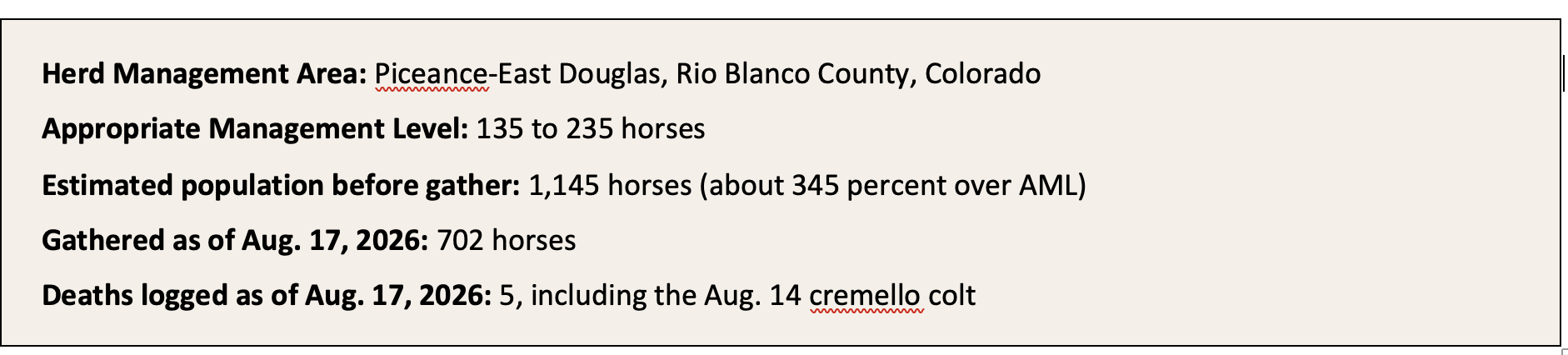
BLM began the Piceance-East Douglas/West Douglas gather around August 1, 2026, with a goal of removing roughly 1,011 of an estimated 1,145 horses from the Piceance-East Douglas Herd Management Area, which BLM says can sustainably support only 135 to 235 head. A companion operation is removing horses from the adjacent West Douglas Herd Area, which has no approved population target at all. As of August 17, BLM's own gather status update listed 702 horses captured, 626 shipped, and 5 deaths since operations began.
THIS IS NOT THE FIRST TIME
Cremello and other blue-eyed horses turning up disproportionately in BLM's euthanasia logs is not a new pattern. In the 2022 South Steens gather in Oregon, BLM euthanized 22 horses for non-gather-related conditions, and 11 of them were cremellos, most cited for the same “eye abnormality/blindness” language seen in the Piceance report. Advocacy groups, including the American Wild Horse Conservation and the Wild Beauty Foundation, have pointed to that ratio for years as evidence that coat color, not confirmed clinical findings, is driving the call.
“A blue iris does not make the horse any more likely to have intraocular problems.” — position commonly attributed to the American Association of Equine Practitioners in advocacy reporting on cremello euthanasia decisions
The veterinary logic advocates point to is specific. Cremello and other double-dilute coat colors carry blue irises, which is a pigmentation trait, not a structural eye defect. What does raise legitimate ophthalmic risk in some light-colored horses is periocular pink skin, which is more prone to solar damage and squamous cell carcinoma over time, particularly in high-UV rangeland environments. That is a real, well-supported clinical concern. It is also a different concern from iris color itself, and the two get conflated easily in a one-line report that just says “eye abnormality/blindness.”
WHAT TRANSPARENCY WOULD ACTUALLY LOOK LIKE
Nobody disputes that BLM's Comprehensive Animal Welfare Program calls for an on-scene or on-call veterinarian to be involved in euthanasia decisions during a gather, and nobody seriously argues that every animal with a genuine, non-recoverable ocular condition should be kept alive and shipped to a holding facility regardless of prognosis. The dispute is narrower and, for veterinary professionals, more familiar: what does the underlying exam actually show, and is it available for review.
A defensible individual welfare decision on blindness or an eye abnormality would typically be backed by findings a field vet could document in a few sentences. Menace response and palpebral reflex results. Pupillary light reflex, direct and consensual. Corneal and lens findings on penlight or slit lamp if available. Any visible mass, ulceration, or discharge. An assessment of whether the animal could navigate a corral or trailer safely. None of that needs a boarded ophthalmologist in the field, and none of it appears in the public daily report for the Piceance colt, or for the other four deaths logged during this gather, which are described with equally brief phrases like “physical deformity, unable to maintain or improve.”
BLM's defenders would note that daily gather reports have never been designed as medical records. They are operational summaries, published quickly, for a public audience, during an active field operation moving dozens of horses a day in triple-digit heat. Requiring full exam documentation in a same-day public post is a different standard than most agencies, or most veterinary practices, apply to any public-facing record. There is also no public evidence in this case, or in the historical record, that a full clinical exam was skipped. The concern raised by advocates is about the absence of documentation, not proof of its absence.
WHY THIS SHOULD MATTER TO THE PROFESSION, NOT JUST THE ADVOCATES
Wild horse and burro gathers run on contract veterinarians and BLM's own veterinary staff, and the welfare calls made in the field become the public face of veterinary judgment in a highly watched, highly litigated space. When the only visible output of that judgment is a five-word cause of death, it puts the profession in the position of being trusted on reputation alone, at exactly the moment public trust in the program is already strained. Fuller field documentation, even in summary form, would do more to defend sound euthanasia decisions than any amount of reassurance after the fact.
The Piceance-East Douglas gather is expected to continue through early September. Whether this particular colt's decision was clinically sound is, on the public record, genuinely unknowable either way. That gap itself is the story.
SOURCING
Cause-of-death entry and gather statistics: BLM Colorado, 2026 Piceance-East Douglas/West Douglas Wild Horse Gather daily reports, published at blm.gov. Historical South Steens euthanasia figures: BLM Oregon-Washington 2022 South Steens Wild Horse Gather daily reports and American Wild Horse Conservation field summaries. Veterinary context on iris pigmentation and periocular skin risk reflects positions commonly cited by advocacy organizations as attributable to the American Association of Equine Practitioners; readers wanting AAEP's own current position should confirm directly with AAEP. Read more about this issue: https://substack.com/home/post/p-211452346
Share This Article
Free Membership
Enjoyed this article?
There's a lot more where that came from.
Join 50,000+ veterinary professionals who get free RACE-approved CE, weekly clinical updates, and the most talked-about veterinary magazine in the profession — all completely free.
Join Vet Candy Free →No credit card. No catch. Just everything veterinary.