

Europe Had FMD for the First Time in 14 Years. Here's What Every Veterinarian Should Take From It
Five countries. Multiple unrelated viral lineages. Nearly 100,000 animals culled. Europe's back-to-back FMD outbreaks between 2025 and 2026 were a real-world stress test of foreign animal disease preparedness — and the system held. Here's why that matters for practitioners in disease-free regions.
By Vet Candy Editorial | June 2026 | Food Animal, Large Animal & Disease Preparedness
Europe had been free of foot-and-mouth disease for nearly 14 years when a herd of water buffalo outside Berlin tested positive in January 2025. The outbreak was contained quickly. Then, two months later, FMD appeared again — this time in cattle herds in Hungary and Slovakia. By early 2026, the disease had surfaced in Cyprus and on the Greek island of Lesbos.
Five countries. Multiple unrelated introductions. Nearly 100,000 animals culled across the affected regions.
What's notable is not that the outbreaks happened — foreign animal disease incursions are a when-not-if proposition for any region with international livestock trade. What's notable is that a handful of outbreaks didn't become a continent-wide crisis. That outcome wasn't accidental. It was the product of preparedness infrastructure built during the years when FMD was absent.
Aleksandra Miteva, head of the Animal Health Unit at the Bulgarian Food Safety Agency, presented the European experience at the AABP Emerging Diseases Virtual Conference, identifying five lessons that apply well beyond Europe. For veterinarians in any disease-free country — including the U.S. — the takeaways are direct and worth sitting with.
The Outbreak Timeline at a Glance
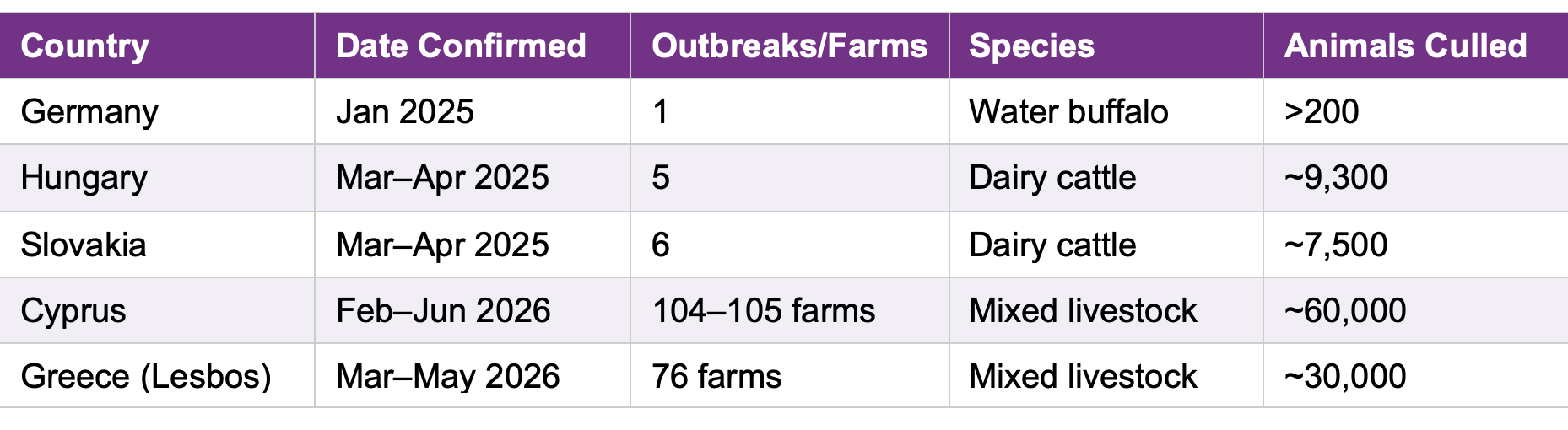
The outbreaks were not linked to a single source. Genetic analysis confirmed the Germany, Hungary, and Slovakia strains were separate introductions; Cyprus and Greece involved a distinct lineage. The fact that multiple unrelated incursions occurred in close succession underscores that disease-free status is not a permanent condition — it's a state that requires active maintenance.
How Europe Contained It
Three tools did the heavy lifting: regionalization, movement controls, and vaccination.
Regionalization was the structural key. Rather than locking down entire countries, authorities designated protection zones, surveillance zones, and restricted zones around affected areas. Disease-free regions continued operating normally. Affected zones received concentrated control resources. In some cases, islands were designated as restricted zones to prevent spread beyond natural geographic boundaries. It's an approach that requires both sophisticated surveillance infrastructure and political will — but it allowed trade and agriculture to continue outside affected areas while the response was underway.
Movement controls accompanied regionalization: animal movement restrictions within and around affected zones, enhanced surveillance, temporary bans on livestock gatherings, and export restrictions where applicable.
Vaccination varied by country and context. The EU maintains an FMD antigen bank with more than 34 million doses that can be rapidly formulated and deployed in an emergency. Hungary and Slovakia used emergency suppressive vaccination in conjunction with stamping out. Cyprus implemented protective vaccination as part of its control strategy.
"Rapid access to the vaccine was crucial," said Miteva.
Five Preparedness Lessons — With Direct Implications for U.S. Practitioners
1. You Can't Build Detection Capacity During an Outbreak
"Early detection is really crucial, and awareness and rapid reporting remain essential," Miteva said. "Contingency plan, awareness campaign, training and diagnostic capacity must remain at an operational level."
The European outbreaks were identified quickly in part because diagnostic capacity was already in place — laboratories that could run tests, veterinarians who knew the clinical presentation, reporting systems that were operational. None of that can be stood up in the days after an index case is confirmed.
For U.S. practitioners, the practical question is whether you could recognize FMD if you saw it. The clinical presentation — vesicular lesions on the mouth, tongue, feet, and teats; hypersalivation; acute lameness in multiple animals simultaneously — is distinctive, but for practitioners who have never seen it and have no reason to keep it top of mind, recognition is not automatic. Foreign animal disease training and familiarity with USDA APHIS reporting protocols are part of your job, even if the disease has been absent for decades.
2. Vaccine Readiness Is Not the Same as Having Vaccines
The EU antigen bank matters because having antigen on hand is only the first part. The second part is having a plan to formulate, distribute, and administer millions of doses rapidly — before the disease spreads further. Countries that used vaccination in the European response were able to do so because the regulatory, logistical, and operational infrastructure for emergency vaccination was already in place.
The U.S. does not currently use FMD vaccination in livestock and does not have a vaccination program active. Understanding what emergency vaccination would look like — and what role veterinary practitioners would play in a large-scale emergency response — is worth knowing before it becomes urgent.
3. Regionalization Requires Surveillance Infrastructure That Doesn't Appear Overnight
Regionalization works because it allows you to draw defensible lines around affected areas and confidently certify that areas outside those lines are disease-free. That confidence depends on robust surveillance — passive reporting from practitioners, active monitoring at borders and markets, and diagnostic capacity to rapidly test suspect cases.
The lesson for disease-free regions is that the surveillance infrastructure enabling regionalization has to exist before an outbreak occurs. Practitioners are a critical node in that system: they're often the first point of contact for producers with sick animals, and their recognition and reporting behavior determines how quickly a potential incursion gets confirmed.
4. Communication Is a Disease Control Intervention
"Communication is the instrument to tackle this issue," Miteva said, speaking to the challenge of maintaining producer cooperation during control measures that involve movement restrictions and depopulation.
Producers cooperate with biosecurity and reporting requirements when they trust the system — when they believe that reporting will be met with support rather than punishment, that control measures are fairly applied, and that their cooperation contributes to an outcome that protects their industry. That trust is built over years of relationship between veterinary practitioners, regulatory agencies, and producer communities. It cannot be improvised during a crisis.
For practicing veterinarians, this is partly about your individual relationships with clients. A producer who trusts you will call you when something looks wrong. A producer who fears the consequences of reporting may not.
5. Disease Control Is Not a Veterinary Problem — It's a System Problem
"This is a joint effort from all stakeholders," Miteva said.
The European response involved veterinarians, producers, diagnostic laboratories, government regulators, industry organizations, and international partners — all operating under pre-established protocols that clarified who does what and when. The veterinary practitioner's role is essential but bounded: recognize, report, and support the response. The broader system has to be in place for that role to matter.
Understanding your role in a foreign animal disease response plan — your state's FAD response protocols, your reporting obligations, your relationship with your state veterinarian's office — is professional infrastructure that should be current, not something to look up if an index case is confirmed.
The Bottom Line for U.S. Practitioners
The U.S. has been FMD-free since 1929. That long absence creates exactly the kind of institutional complacency that makes preparedness harder to maintain — it's difficult to sustain urgency around a disease that no one in practice has ever seen.
Europe's experience is a useful corrective. The disease returned after 14 years — a fraction of the U.S. disease-free interval — and it returned through multiple unrelated incursions in rapid succession. Containment worked because preparation had been maintained during the absence. If it hadn't, the outcome would have looked very different.
Foreign animal disease preparedness is not glamorous continuing education. It's also not optional for practitioners who work with livestock.
Resources
USDA APHIS Foreign Animal Disease Preparedness: aphis.usda.gov/fadprep
USDA APHIS — Report a Suspected FAD: 1-866-536-7593 (24/7 FAD Hotline) | aphis.usda.gov
AABP Emerging Diseases Resources: aabp.org
WOAH (World Organisation for Animal Health) — FMD: woah.org — Foot-and-Mouth Disease
Related Reading on Vet Candy
Food Animal & Disease Preparedness Content: Explore food animal content on Vet Candy
Our Screwworm Coverage (Active U.S. Outbreak): New World Screwworm — What Veterinarians Need to Know
Share This Article
Free Membership
Enjoyed this article?
There's a lot more where that came from.
Join 50,000+ veterinary professionals who get free RACE-approved CE, weekly clinical updates, and the most talked-about veterinary magazine in the profession — all completely free.
Join Vet Candy Free →No credit card. No catch. Just everything veterinary.