

NAVLE 2026–2027 Candidate Handbook: Everything Candidates Need to Know
The ICVA just released the updated 2026–2027 NAVLE Candidate Handbook, and the changes this cycle are more significant than most candidates realize. New exam structure, updated software, revised policies, and a set of rules worth knowing before you ever touch the application.
We read the whole thing so you don't have to miss anything important. Here is your complete overview.
What's New: The Biggest Change in the Exam Structure
Starting with the October–November 2026 testing window, the NAVLE moves from six blocks of 60 questions to twelve blocks of 30 questions. The total is still 360 questions. The content hasn't changed. The delivery has.
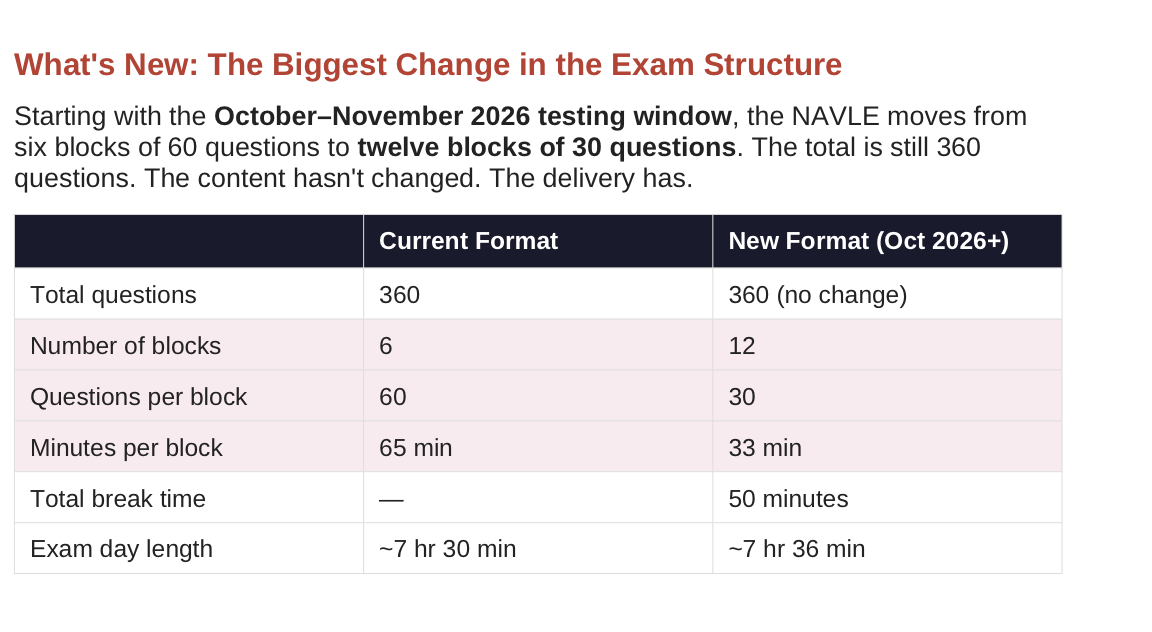
The research behind this change is solid: shorter blocks with more frequent breaks reduce fatigue and support more stable performance across the exam. This is a candidate-forward improvement, and it aligns the NAVLE with other major medical licensing exams.
For your prep: Start practicing in 30-question blocks, not 60. Train your brain on the new rhythm now — the pacing and break strategy are slightly different when you have twelve segments instead of six.
New Software — What's Different on Your Screen
The new block structure comes with updated exam software. Here's what's changing:
• Updated interface design and improved keyboard navigation
• A new settings menu
• The ability to adjust image contrast during the exam — plus existing zoom and pan tools for clinical photos and radiographs
About 15–20% of NAVLE questions include graphics. The image contrast adjustment is a meaningful improvement for anyone who has struggled with visual question clarity on previous attempts.
The 2026–2027 Testing Windows
The NAVLE is offered three times per year. Here are all three windows for this cycle:
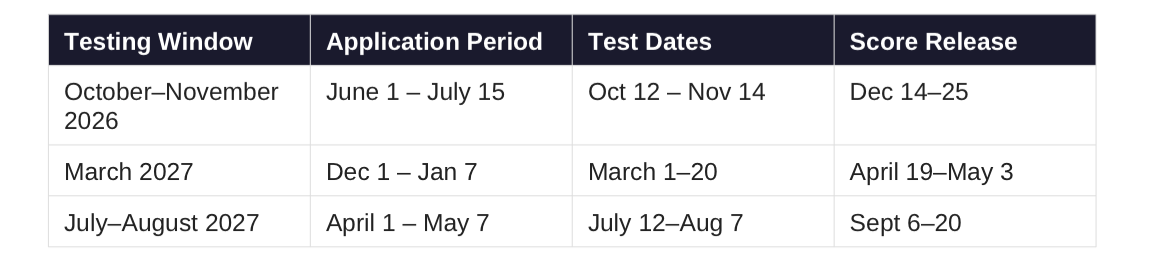
⚠️ No extensions. No exceptions. If you miss your application window or don't test during your approved window, you reapply and pay the full fee again. Plan ahead.
Fees — Know What You're Paying
• Standard NAVLE fee (U.S., U.S. territories, Canada): $825
• International NAVLE fee (testing outside U.S./Canada): $1,220 ($825 + $395 international)
• Testing region change fee: $100 (must be requested at least 10 business days before window opens)
• Approval fee: $55
The fee is nonrefundable and nontransferable. No exceptions. If your application is rejected, you're ineligible, or you don't test — you pay again.
Eligibility — Who Can Apply
AVMA COE-Accredited Schools
If you're enrolled in or graduated from an AVMA COE-accredited school, you're on the standard eligibility path. A few key rules:
• Students may take the NAVLE up to two (2) times before graduation. •
• In Canada and most U.S. states, if you haven't graduated yet, your expected graduation date must be within 10 months of the last date of the testing window you're applying for.
• Your school must be AVMA COE-accredited at the time of your graduation — not just when you enrolled.
Non-Accredited Programs (International Graduates)
If you graduated from a non-AVMA COE school, you're eligible through one of two pathways:
• ECFVG (Educational Commission for Foreign Veterinary Graduates) — you must complete the BCSE exam before applying for the NAVLE.
• PAVE (Program for the Assessment of Veterinary Education Equivalence) — you must complete the QSE exam before applying.
⚠️ Lifetime limit: 5 NAVLE attempts. Each administration counts toward your limit — including cancelled or invalidated scores — unless the cancellation was due to systemic/external circumstances beyond your control.
Accommodations — Deadlines You Cannot Miss
If you need ADA testing accommodations, submit your Accommodation Request Packet before or during the application period — not after. Deadlines are fixed and do not change even if testing windows expand.
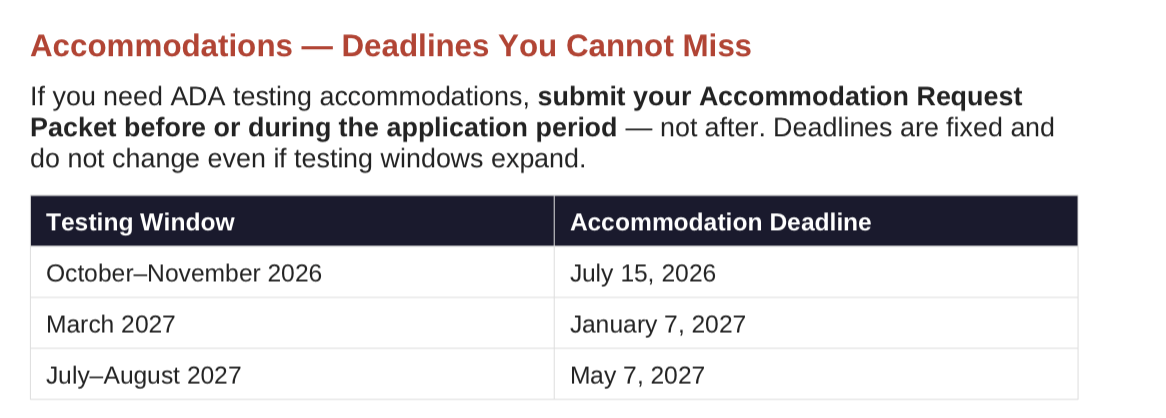
Once approved, accommodations apply to all future attempts — as long as you indicate on each application that you're requesting the same ones. If your accommodations require extended time or more frequent breaks, you will test over two days.
Non-standard testing conditions (temporary conditions like post-surgery or injury) require a separate packet submitted at least 14 days before the testing window opens, with a letter from a qualified healthcare provider.
What to Expect on Exam Day
Before You Arrive
• Bring your Scheduling and Admission Permit (digital or physical)
• Bring a valid, unexpired government-issued photo ID with signature — must match your permit name exactly
• Arrive at least 30 minutes early — arriving more than 30 minutes late means you cannot test
• No guests are permitted at the test center — no waiting areas for family or friends
What You Cannot Bring Into the Testing Room
Nothing except water in a clear container with a lid. The following are explicitly prohibited:
• Electronic devices of any kind, including phones, smart glasses, and watches (analog or digital)
• Bags, backpacks, purses, outerwear, brimmed hats
• Books, notes, study materials, calculators
• Food or beverages other than water in a clear/transparent capped container
Everything goes in a locker outside the testing area.
Breaks
You have 50 minutes of total break time across the exam. Breaks are only permitted between testing blocks — not during them.
⚠️ Taking a break during a block triggers an incident report and could be investigated as an exam security violation. The clock does not stop during unauthorized breaks.
New: AI Is Explicitly Prohibited
The 2026–2027 Candidate Agreement explicitly prohibits accessing any large language model or generative AI platform — including ChatGPT — during the exam administration. This is now spelled out in the Candidate Agreement you sign. However, since you don’t have any devices with you, not sure how this would be possible.
Content Blueprint — What You're Tested On
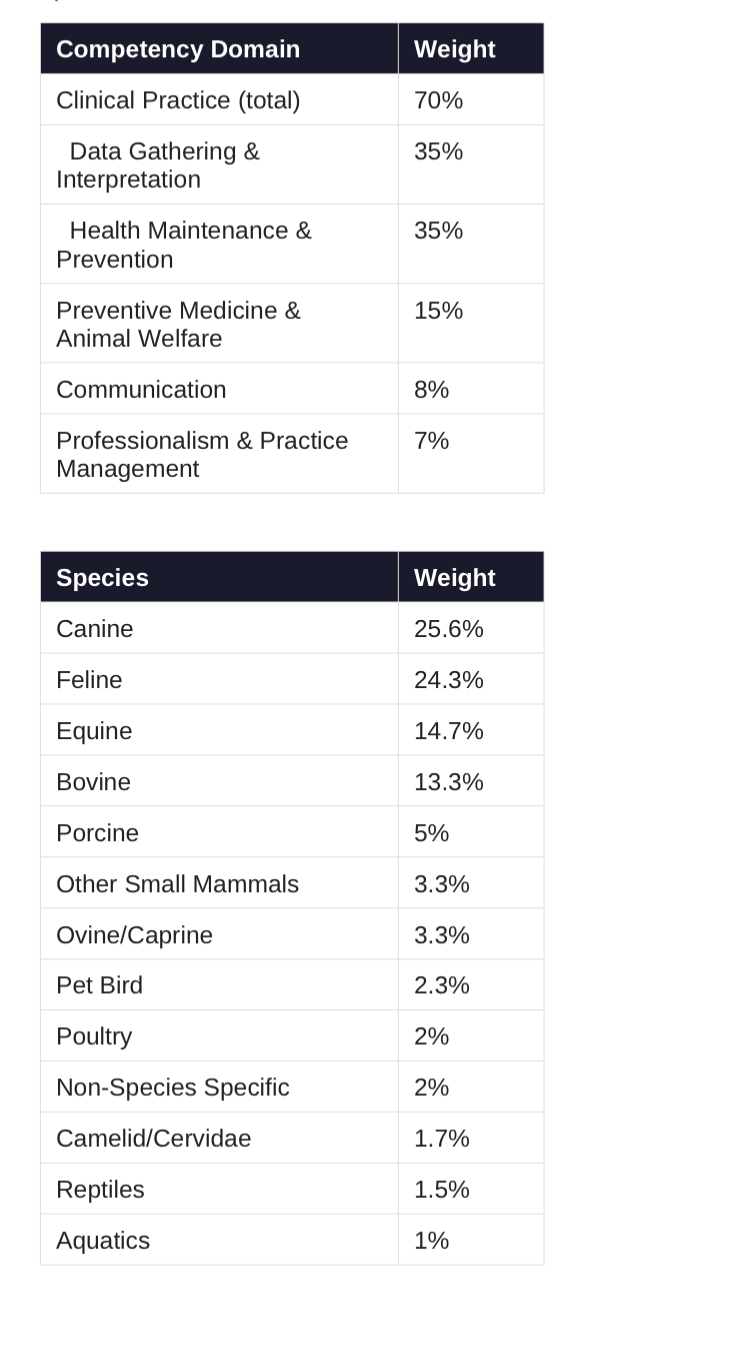
The NAVLE content has not changed. Here's the breakdown by competency and species:
After the Exam: Getting Your Results
• Scores are released 4–5 weeks after the testing window closes
• You'll receive an email with instructions to access your score report through the secure MyNBME portal
• Your report includes: pass/fail designation, three-digit scaled score, and performance diagnostics by content area
• No rescores. No appeals of NAVLE results. The score is the score.
• Score transfers to licensing boards go through the AAVSB VAULT Transfer Services — not through ICVA
Score Cancellation: Know Your Rights
ICVA can cancel, invalidate, or withhold scores for several reasons. Here's the part worth understanding:
• If your score is cancelled due to validity concerns with your own data and you didn't violate the Candidate Agreement, you get one free retake. If that one is also cancelled, you pay full fee going forward.
• If your score is cancelled due to systemic or external circumstances — exam compromise, technical failure, test administration errors — you get a free retake that doesn't count against your 5-attempt lifetime limit.
• If you violated the Candidate Agreement, there is no free retake and the attempt still counts toward your limit.
The Self-Assessment Has Been Updated Too
ICVA's official NAVLE Self-Assessment has been updated to reflect the new 12-block format. It offers 200 multiple-choice questions across four blocks of 50 questions each, in regular or expanded feedback format, in English or French.
It generates a projected NAVLE score range and a performance breakdown by blueprint area. Available for purchase through icva.net. If you haven't used it before, it's worth the investment — it's the only practice material built on the actual exam blueprint.
The Checklist: Before You Apply
• Read the full Candidate Handbook at icva.net
• Confirm your school is AVMA COE-accredited
• Check your graduation date falls within the 10-month window rule
• If you need accommodations, submit your packet before the application deadline — not during
• Make sure the name on your application matches your government-issued ID exactly
• Confirm which approval process applies to you — Canada (NEB), U.S. board, or 'no board' ICVA option
• For October–November 2026: application window opens June 1 and closes July 15
───────────────────────────────
NAVLE Warriors is Vet Candy's free 12-week NAVLE prep program, built directly around the ICVA Diagnosis and Species list. Tuskegee University CVM's first-time NAVLE pass rate improved from 51% to 74% after integrating NAVLE Warriors. Free, effective, and built for this