Navigating the Many Paths of Small Animal Practice
Veterinary medicine is a field with extraordinary opportunity imagine veterinarians as doctors in white coats treating pets in exam rooms, the reality is far more complex. Careers span from hands-on patient care to executive leadership, from emergency rooms to shelters, from small private practices to large corporate chains, and from rural mixed practices to highly specialized urban hospitals. Understanding these pathways can help veterinarians make intentional choices about where to focus their skills, energy, and professional growth.
Which Vet Career Fits Your Style?
Veterinary medicine offers countless paths—each with its own pace, challenges, and rewards. This quiz is designed to help you see where your skills, values, and preferences align so you can make informed career decisions. Answer honestly, and at the end, your results will highlight the veterinary roles that suit you best.
Questions
Q1. What excites you most about being a veterinarian?
a. Working directly with patients and clients every day (Associate / Clinical Practice)
b. Diving deep into complex, challenging medical cases (Specialist)
c. Caring for many animals at a population level and improving community health (Shelter / Public Health)
d. Solving urgent, high-stakes cases in a fast-paced environment (ER / Urgent Care)
e. Shaping the culture, strategy, and growth of a practice or organization (Owner / Executive)
Q2. What type of work environment energizes you?
a. A general practice clinic with familiar patients and steady routines (Associate / GP)
b. A specialty hospital or referral center with advanced diagnostics (Specialist)
c. A shelter or community clinic where resources are limited but impact is high (Shelter Medicine)
d. A busy ER or urgent care with unpredictable, high-pressure cases (ER / Urgent Care)
e. A corporate office, practice ownership, or leadership role with strategic decisions (Corporate / Owner / Executive)
Q3. How do you feel about taking on business or administrative responsibilities?
a. I prefer to focus on medicine and patient care (Associate / GP / Specialist / Shelter)
b. I can handle some tasks if it supports better patient care (Specialist / Mixed Practice)
c. I enjoy influencing policies, workflows, or strategic decisions (Owner / Executive / Corporate)
d. I want clear roles and responsibilities, with leadership handled by others (ER / Urgent Care)
Q4. What matters most in your career right now?
a. Hands-on clinical experience and relationships with clients and patients (Associate / GP / Specialist)
b. Mastering a medical specialty or building clinical expertise (Specialist)
c. Making a measurable impact on animal welfare at scale (Shelter / Public Health)
d. The adrenaline and problem-solving of high-pressure cases (ER / Urgent Care)
e. Shaping long-term growth, culture, or financial outcomes (Owner / Executive / Corporate)
Q5. How do you feel about your schedule and work-life balance?
a. Flexible but mostly predictable schedule is ideal (Shelter / Corporate)
b. Irregular hours, nights, and weekends are fine if the cases excite me (ER / Urgent Care)
c. I can handle intensive work early if it leads to mastery or leadership later (Specialist / Owner / Executive)
d. I want consistency but can adapt occasionally (Associate / Mixed Practice)
Q6. How important is career growth, ownership, or leadership to you?
a. Not a priority—I’m focused on clinical excellence (Associate / GP / Specialist)
b. Some interest in partnership or equity if it aligns with patient care (Mixed Practice / Specialist)
c. High priority—I want to shape the practice or organization (Owner / Executive / Corporate)
d. I care more about learning and specialty development than ownership (Specialist / ER / Shelter)
Q7. How do you handle stress and unpredictability?
a. I prefer steady routines and manageable challenges (Associate / GP / Shelter)
b. I thrive under pressure and enjoy thinking quickly on my feet (ER / Urgent Care)
c. I like to plan strategically to mitigate risk before it happens (Owner / Executive / Corporate)
d. I embrace complexity and enjoy solving detailed, technical problems (Specialist / Mixed Practice)
Scoring Guide
Mostly A’s:Associate / General Practice – You thrive on hands-on care, steady patient relationships, and honing your clinical skills.
Mostly B’s:Specialist / Advanced Practice – Complex cases, deep expertise, and continuous learning energize you.
Mostly C’s:Shelter / Public Health – Impact at the population level and community service are your driving forces.
Mostly D’s:ER / Urgent Care – Fast-paced, high-intensity medicine gives you the satisfaction of immediate results.
Mostly E’s:Owner / Executive / Corporate – You are motivated by influence, strategy, and shaping veterinary operations or culture.
Mixed answers: You may enjoy hybrid roles, such as a GP with specialty focus, mixed practice, or leadership in a specialty or corporate environment.
The Associate Veterinarian: Learning the Ropes
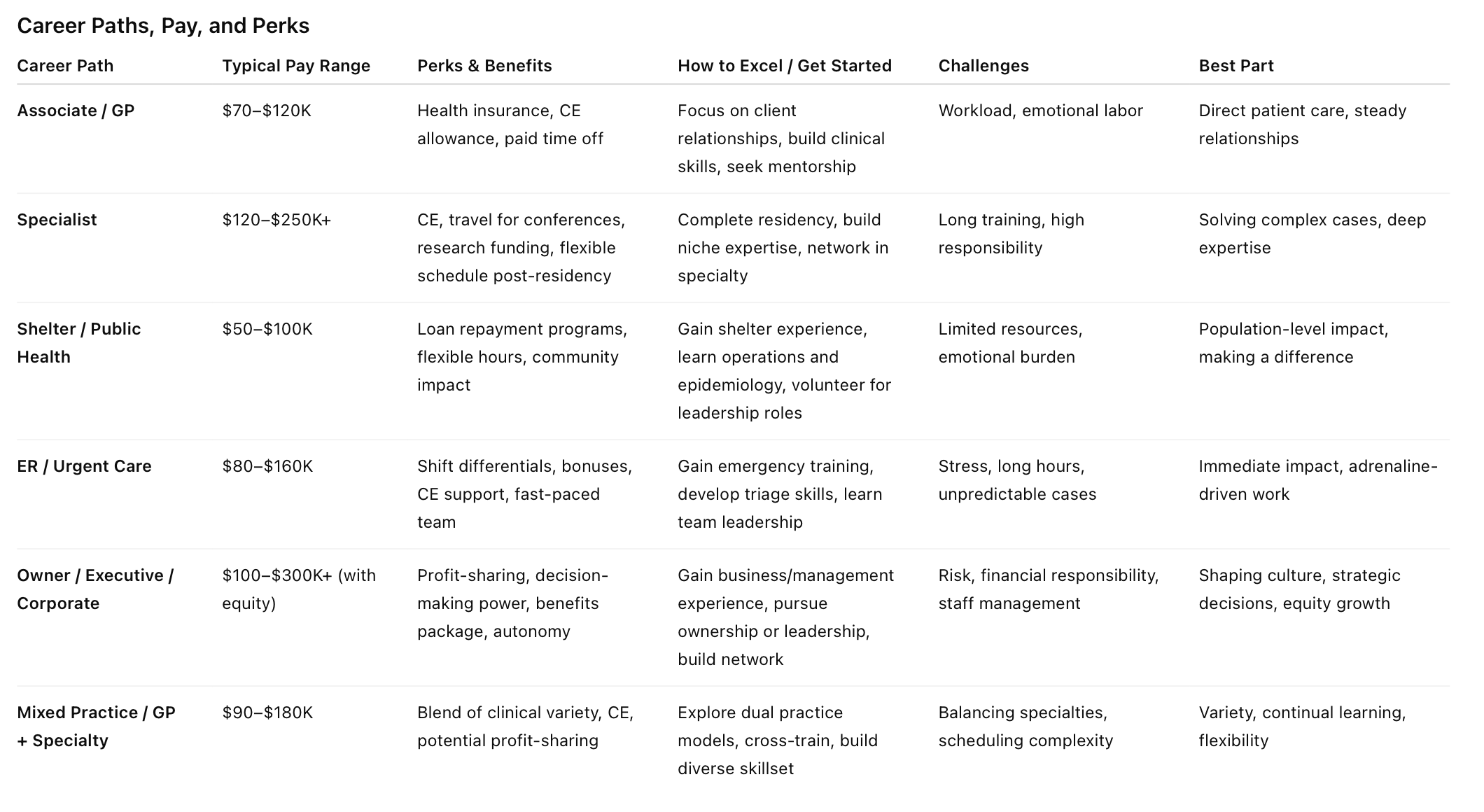
For most veterinarians, the first professional step is an associate role in a general practice. As an associate, the focus is on developing clinical expertise, building confidence, and learning how practices function day to day. The joy comes from hands-on care and forming meaningful connections with patients and clients, but the role can be challenging. Associates often have limited authority and must adapt to high workloads and diverse cases. To thrive, young veterinarians should seek mentorship, engage in continuing education, and cultivate strong communication and teamwork skills. These early years are foundational, providing the experience needed to decide whether to stay in general practice, pursue specialty training, or eventually step into leadership or ownership roles.
Specialty and Mixed Practice: Deep Knowledge Meets Broad Care
Some veterinarians are drawn to mastering a particular discipline, whether it’s surgery, internal medicine, or oncology. Specialists dedicate years to advanced training and residency programs, developing deep expertise that allows them to tackle complex, high-stakes cases. The satisfaction of solving challenging medical puzzles and contributing to cutting-edge care is immense, but the journey is demanding. Success requires dedication, mentorship, and the ability to continually update one’s knowledge.
Other veterinarians thrive in mixed practice, often in rural or semi-rural settings, treating multiple species and adapting to a constantly changing case load. The variety keeps daily work interesting, but it demands broad knowledge and flexibility. Networking with specialists and maintaining strong continuing education are essential for excelling in this environment.
Shelter Medicine: Caring at the Community Level
Shelter veterinarians occupy a unique niche, focusing on population health, preventive medicine, and community impact. Their work saves lives on a large scale and often involves creative problem-solving in resource-limited settings. Emotional resilience and operational skills are key to navigating limited budgets and high caseloads. For those drawn to public service and large-scale impact, shelter medicine offers professional fulfillment and the opportunity to shape community health programs.
Emergency, Urgent Care, and High-Intensity Roles
Emergency and urgent care veterinarians experience fast-paced, high-stakes medicine every day. Decisions must be made quickly, often under pressure, and emotional intensity is high. These roles require confidence, rapid clinical reasoning, and the ability to collaborate seamlessly with support staff. The reward lies in life-saving interventions and immediate, tangible impact. Certifications in emergency medicine and rotations in high-intensity clinics help build the necessary skill set, while resilience and stress management are critical for long-term success.
Private vs. Corporate Practice
The choice between private and corporate practice shapes the veterinarian’s daily life and career trajectory. Private practice offers autonomy, creative control, and potential ownership opportunities, but comes with business responsibilities and financial risk. Corporate practice provides structured career advancement, training programs, and financial stability, though autonomy is often more limited, and veterinarians may face performance metrics and corporate policies. Excelling in either environment requires understanding the business, developing leadership skills, and adapting to the organizational culture.
Ownership and Executive Leadership
Some veterinarians aim for ownership or executive roles, from partial equity partners to chief medical officers. These positions allow professionals to influence culture, strategy, and business outcomes, but they also carry high responsibility. To succeed, veterinarians need business acumen, leadership ability, and a clear vision for growth. Gaining management experience, pursuing additional training, and building a trusted network are essential steps toward leadership success. The reward is significant: career autonomy, long-term financial growth, and the opportunity to leave a lasting professional legacy.
Choosing the Path That Fits You
Veterinary medicine offers a spectrum of professional experiences, each with unique rewards and challenges. Early-career associates focus on building expertise, while specialists and mixed-practice veterinarians balance depth and variety. Shelter medicine and public health emphasize population-level impact, whereas emergency medicine tests speed and composure under pressure. Private and corporate practice shape the professional environment, and ownership or executive roles define long-term influence and responsibility.
Success in any pathway requires self-awareness, continued learning, and strategic career planning. By understanding the landscape of veterinary practice and the demands of each role, veterinarians can make informed choices that align with their skills, values, and ambitions—whether their goal is direct patient care, public health impact, or executive leadership.