

Former Wild Mustang Survives Botulism Scare
In 2016, then 4-year-old Mustang mare Magic was one of 279 wild horses rounded up by the Bureau of Land Management (BLM) following the massive Soda Fire in Idaho, which destroyed more than 279,000 acres of their critical habitat. To prevent their starvation, BLM rescued the wild horses. Between 2016 and 2019, many of the horses, including Magic, were adopted out, and others were returned to the wild when their grazing area grew back.
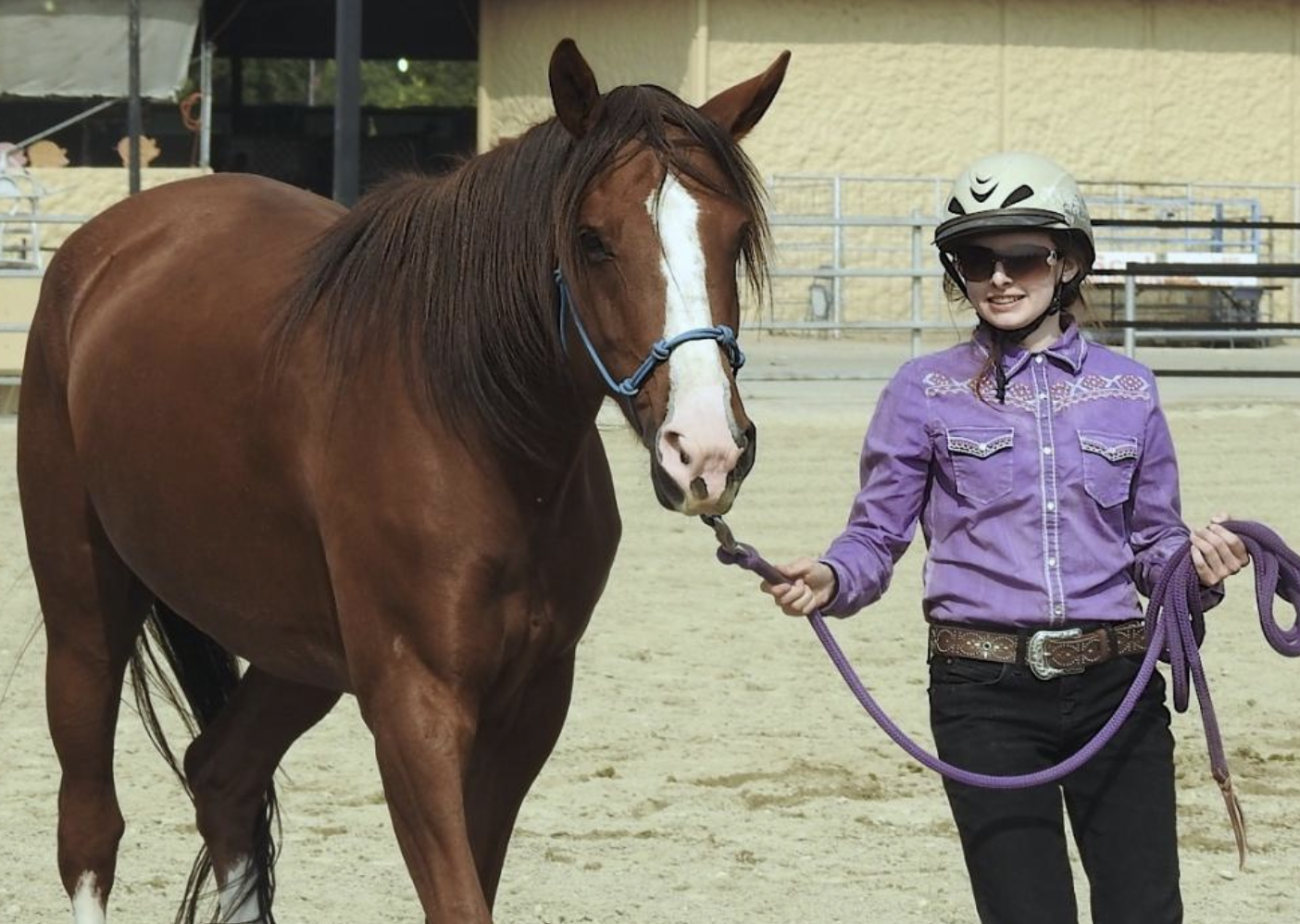
Fast forward to September 2025 and Magic, now 13, is living a good life in Northern California with adopter Tiffany Tarbet. But following two bouts of colic and a suspected case of stomach ulcers all within a month, Magic was found frothing at mouth in an abnormal state. Tarbet called the UC Davis Equine Field Service—who had treated Magic previously—back to her stable for immediate help.
Given Magic’s history over the previous month, her care team felt it was best to bring her back to the UC Davis Large Animal Hospital for further testing.
Based on Magic’s presentation, including inability to move her tongue and swallow appropriately, reduced eyelid and tail tone, and overall body weakness with low neck carriage and muscle tremors, botulism was highly suspected, and Magic was placed in the Equine Intensive Care Unit and administered antitoxins.
Botulism in horses is a severe, often fatal neuromuscular disease caused by Clostridium botulinum toxins, leading to progressive flaccid paralysis, muscle weakness, and inability to swallow. It occurs via ingestion of toxins (forage poisoning), wound infection, or foals producing toxins in their gut. Immediate veterinary care and antitoxins are critical for survival.
“If we had waited one more day later for treatment, Magic would’ve died,” said Tarbet.
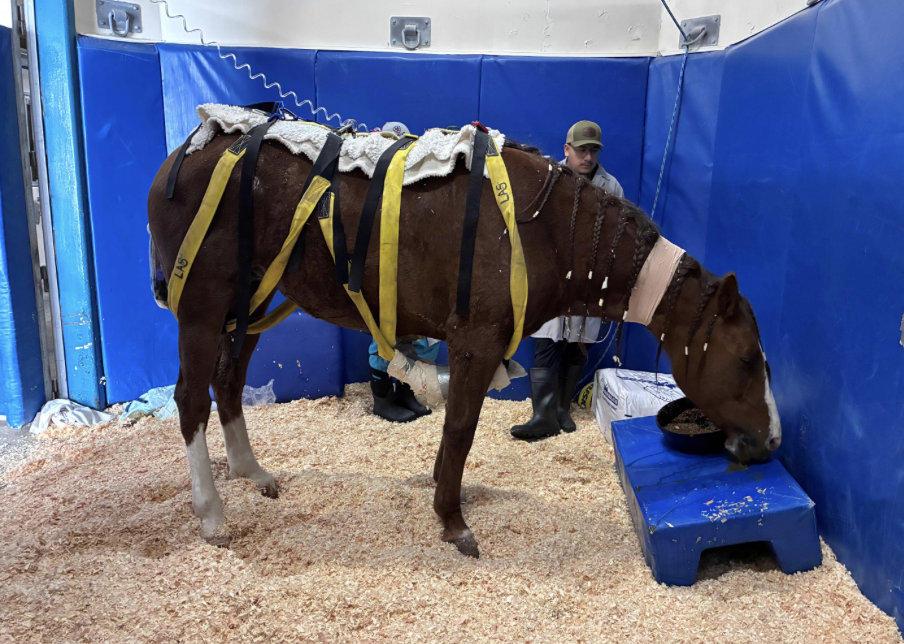
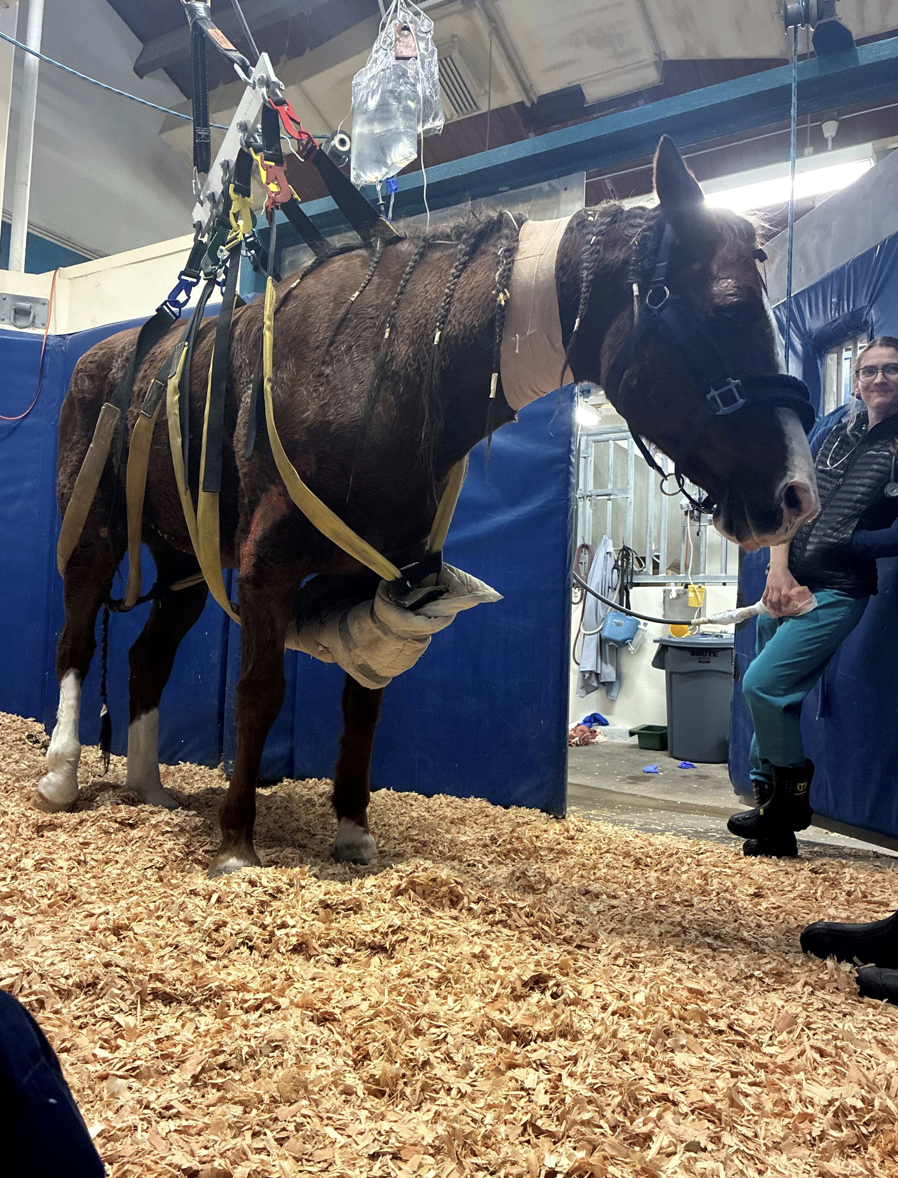
Almost immediately upon hospitalization, Magic struggled to stand and was raised to her feet with the assistance of the “Large Animal Lift.” This pulley system can lift several thousand pounds and helped Magic to stand whenever necessary.
“Magic was very critical for the first two weeks,” said Dr. Emily Berryhill, chief of the Equine Internal Medicine Service. “She required daily lifting and rotating since she was too weak to stand on her own, feeding via a nasogastric tube, a urinary catheter, and around-the-clock supervision.”
Magic eating in her stall at the UC Davis Large Animal Hospital.
She was ultimately hospitalized for nearly six weeks. Thankfully, Tarbet lives nearby and was able to visit almost every day.
Magic consistently improved throughout her hospitalization and was able to stand on her own in the fourth week. While she continued to show muscle weakness and had lost weight and muscle mass, she was stable on her walks through her fifth week. After 39 days, her care team was confident to discharge her to continue her recovery at home.
Tarbet reported it took almost four months for Magic to regain all her weight and strength. She has now made a full recovery and is a happy horse once again.
“She was so happy to get back out in the pasture when recovered,” Tarbet said. “She was running around excited and neighing. She feels great now.”
One of the unique advantages of having a critical animal like Magic treated at UC Davis is the hospital’s large number of veterinarians, technicians, and students to care for them. Magic required dozens of faculty, staff, and students to meet her medical needs, all dedicated to the goal of returning her to health.
“I really appreciate everything UC Davis did for Magic,” said Tarbet. “She wouldn’t have made it without their help.”
From the initial visits by the Equine Field Service, through intake, intensive care, and continued hospitalization, Magic was cared for by: house officer veterinarians Drs. Hillary Bunay (large animal medicine resident), Maria Calero (field service intern), Mathilde Fournier (large animal medicine resident), Mitja Miklavcic (equine emergency and critical care fellow), and Mimi von Zitzewitz (field service intern); faculty internists Drs. Berryhill, Rana Bozorgmanesh, Gary Magdesian, and Camilo J. Morales; and several technicians and students.
“Magic was a huge labor of love for our equine medicine team and, we want to give a grateful recognition to the technicians who were also critical to her around-the-clock needs,” said Dr. Berryhill. “We are so thrilled she is now back to running around the pasture.”
Share This Article
Free Membership
Enjoyed this article?
There's a lot more where that came from.
Join 50,000+ veterinary professionals who get free RACE-approved CE, weekly clinical updates, and the most talked-about veterinary magazine in the profession — all completely free.
Join Vet Candy Free →No credit card. No catch. Just everything veterinary.