

What’s Your Communication Style? Take the Quiz That Could Shape Your Career
Success in veterinary medicine is not just about what you know. It is about how you think, how you communicate, and how you make decisions when it matters most.
Some veterinarians thrive in structured, detail-oriented environments where data drives every choice. Others excel in fast-paced settings that demand quick thinking and decisive action. Some build their careers around strong client relationships, while others are drawn to innovation and big-picture impact.
The difference is not skill. It is alignment.
Understanding your natural communication style can help you choose a career path where you perform at your best, communicate more effectively, and feel more confident in your day-to-day work.
Understanding Communication Styles: The Secret to Thriving in Veterinary Medicine
In veterinary medicine, success is about far more than clinical knowledge. The best clinicians don’t just diagnose and treat—they communicate, lead, and collaborate under pressure. Yet many veterinarians struggle not because they lack skill, but because their communication style doesn’t align with the people around them. Understanding your own style—and the styles of those you work with—can be transformative.
Why Communication Styles Matter
Every interaction in veterinary medicine is a mix of thought, emotion, and action. Misunderstandings often arise not from incompetence, but from differences in how we process information, make decisions, and relate to others. These differences shape team dynamics, client satisfaction, and ultimately career success.
There are four primary communication styles: Analyst, Driver, Connector, and Visionary. Each brings unique strengths to veterinary work, but also specific challenges. Learning to recognize these styles—and how they interact—can reduce friction, increase efficiency, and help teams thrive under stress.
Take the quiz below to find out where you fit and keep score of your ADCV points.
QUIZ: Your Communication Style
Purpose: Identifies your dominant communication style and how it aligns with veterinary career environments. Inspired by Myers-Briggs and DISC frameworks and adapted for veterinary professionals.
Format: 12 questions, 4 answer options each. Each answer corresponds to one of four styles:
Analyst (A)
Driver (D)
Connector (C)
Visionary (V)
Keep track of your answers. Your highest total determines your dominant style.
Questions
Q1. When you're working through a difficult clinical case, you prefer to:
a. Think it through quietly before discussing anything (A+2)
b. Talk it through with a colleague right away (C+2)
c. Research the literature and gather data first (A+2, D+1)
d. Trust your gut and act, then reflect afterward (D+2)
Q2. When giving feedback to a team member, you naturally lead with:
a. The facts and data about what happened (A+2)
b. How it affected the team or the patient (C+2)
c. A direct, bottom-line assessment (D+2)
d. The person's feelings and perspective first (C+2)
Q3. Your ideal workday looks like:
a. Mostly scheduled structure I can plan around (A+2)
b. Fast-paced with clear goals and quick decisions (D+2)
c. Collaborative and relationship-driven throughout (C+2)
d. Creative and open-ended with room to explore (V+2)
Q4. In a team conflict, your first instinct is to:
a. Analyze what went wrong before I respond (A+2)
b. Take charge and resolve it decisively (D+2)
c. Make sure everyone feels heard before moving forward (C+2)
d. Look for the big-picture perspective others are missing (V+2)
Q5. How do you make major career decisions?
a. I research thoroughly and weigh every option carefully (A+2)
b. I decide quickly based on my goals, analysis can come later (D+2)
c. I talk it through with people I trust before deciding (C+2)
d. I follow what excites and energizes me most (V+2)
Q6. At a veterinary conference, you are most likely to:
a. Attend structured CE sessions and take detailed notes (A+2)
b. Network strategically and collect the contacts I came for (D+2)
c. Reconnect with colleagues and build real relationships (C+2)
d. Explore new ideas and get inspired by big-picture talks (V+2)
Q7. When you read a clinical paper or industry report, you:
a. Read every word and verify the methodology (A+3)
b. Skip to the conclusions and implications (D+2)
c. Think about how this affects patients and colleagues you know (C+2)
d. Get excited about what this could mean for the future (V+2)
Q8. How do you handle an unexpected emergency during your workday?
a. Systematic, assess, gather information, act in order (A+2)
b. Decisive, take control of the situation immediately (D+3)
c. Collaborative, involve the team and communicate constantly (C+2)
d. Adaptive, read the situation and fill whatever gap is needed (V+2)
Q9. When something at work frustrates you, you:
a. Document the issue and research possible solutions (A+2)
b. Address it directly with whoever can fix it (D+2)
c. Talk to a trusted colleague first to process (C+2)
d. Step back and think about the broader cause (V+2)
Q10. Your biggest professional strength is:
a. I am thorough, accurate, and I do not miss details (A+3)
b. I get things done and drive results (D+3)
c. I build trust and bring people together (C+3)
d. I see possibilities others do not see yet (V+3)
Q11. In five years, you would most like to be known for:
a. Being highly knowledgeable and reliable (A+2)
b. Building something and leading it successfully (D+2)
c. The relationships and community I built (C+2)
d. The ideas I introduced that changed how things work (V+2)
Q12. When you are at your best at work, you feel:
a. In control, prepared, and highly competent (A+2)
b. Productive, decisive, and effective (D+2)
c. Connected, appreciated, and helpful to others (C+2)
d. Inspired, creative, and energized (V+2)
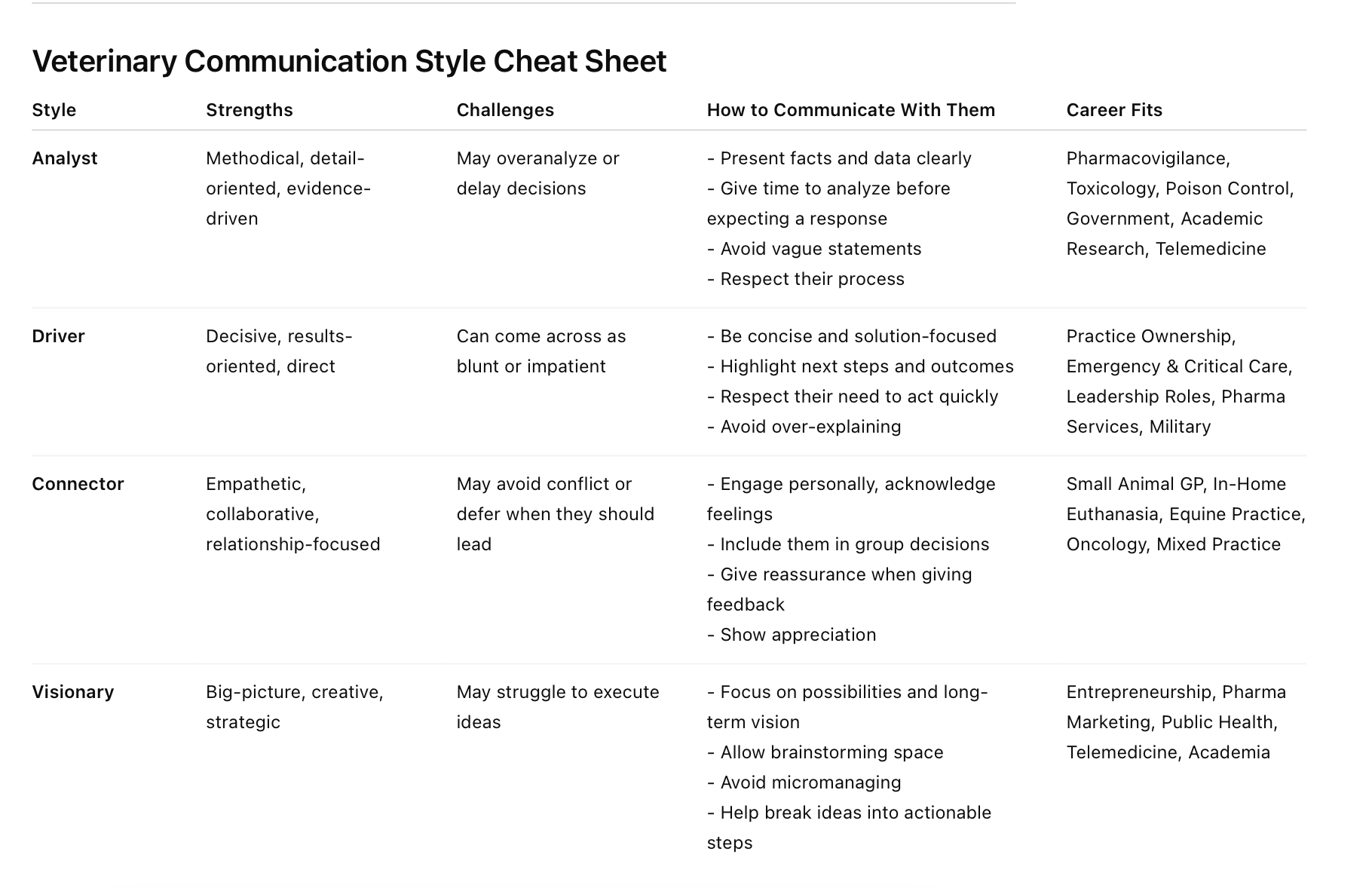
Meet the Styles and How to Communicate With Them
Analyst
Traits: Methodical, detail-oriented, evidence-driven. Analysts excel in environments where accuracy and data guide decision-making.
Challenge: Analysts may overanalyze or delay action while gathering more information.
Career fits: Pharmacovigilance, toxicology, poison control, government roles, academic research, telemedicine.
How to communicate effectively:
Present facts, data, and clear reasoning.
Be patient with their need to analyze before acting.
Avoid vague statements; precision earns trust.
Give them time to respond—they value thoughtfulness over speed.
Driver
Traits: Decisive, results-oriented, direct. Drivers thrive in fast-paced, high-stakes situations where leadership and action are crucial.
Challenge: Their blunt approach can sometimes strain relationships with colleagues who need process and reassurance.
Career fits: Practice ownership, emergency and critical care, leadership roles, pharmaceutical services, military.
How to communicate effectively:
Be concise and focus on results.
Respect their need to make quick decisions.
Avoid over-explaining unless asked.
Highlight solutions and next steps, not just problems.
Connector
Traits: Empathetic, relationship-focused, collaborative. Connectors build trust naturally and excel at managing client and team relationships.
Challenge: They may avoid conflict or defer decisions, even when their voice should lead.
Career fits: Small animal general practice, in-home euthanasia, equine practice, oncology, mixed practice.
How to communicate effectively:
Engage them personally—acknowledge feelings and relationships.
Involve them in group decisions; they value consensus.
Give reassurance before delivering criticism or difficult news.
Show appreciation—they respond strongly to recognition and connection.
Visionary
Traits: Creative, big-picture thinkers, energized by possibility. Visionaries excel in environments where innovation and strategic thinking are valued.
Challenge: They may struggle to turn ideas into actionable steps.
Career fits: Entrepreneurship, pharmaceutical marketing, public health, telemedicine, academia.
How to communicate effectively:
Focus on possibilities and long-term vision.
Allow space for brainstorming and unconventional solutions.
Avoid micromanaging or insisting on strict procedures.
Help translate ideas into practical next steps—they value guidance on execution.
How Styles Interact
Analyst + Driver
Analysts want more data; Drivers want decisions now. Alone, this can create tension. Together, they balance precision with action: the Analyst ensures correctness, the Driver ensures momentum.
Analyst + Connector
Analysts focus on logic, Connectors on people. This pairing ensures decisions are both accurate and understood by clients and colleagues.
Analyst + Visionary
Analysts ground ideas in reality; Visionaries push boundaries. Together, they turn ambitious ideas into feasible plans.
Driver + Connector
Drivers push for results; Connectors protect relationships. When balanced, they drive outcomes without sacrificing trust or team cohesion.
Driver + Visionary
Visionaries create bold ideas; Drivers turn them into action. This combination powers innovation, growth, and effective leadership.
Connector + Visionary
Visionaries inspire possibilities; Connectors bring people along. This pairing transforms ideas into shared culture and lasting impact.
The Practical Impact
In veterinary medicine, communication is not optional. Every team interaction, client conversation, and emergency decision relies on it. Misalignment between style and environment contributes to stress, frustration, and burnout.
By understanding your own communication style and learning to adapt to others:
You reduce conflict before it starts.
You improve client comprehension and compliance.
You strengthen teamwork under pressure.
You position yourself as a natural leader, regardless of title.
Why This Is a Career Game-Changer
Burnout is often misdiagnosed as a workload issue. More often, it is a misalignment issue—between your style, your team, and your environment. Clinicians who understand styles work smarter, feel more engaged, and achieve better outcomes.
The most successful veterinarians are not just the smartest clinicians—they are the ones who understand the people around them, adapt their communication, and lead with intention. Master this, and you don’t just survive in veterinary medicine—you thrive.