

Our September Magazine: Big Hearts ❤️, Big Breakthroughs
Welcome to our September issue—a heartfelt edition packed with breakthroughs, compassion, and a little something for every corner of the veterinary world.
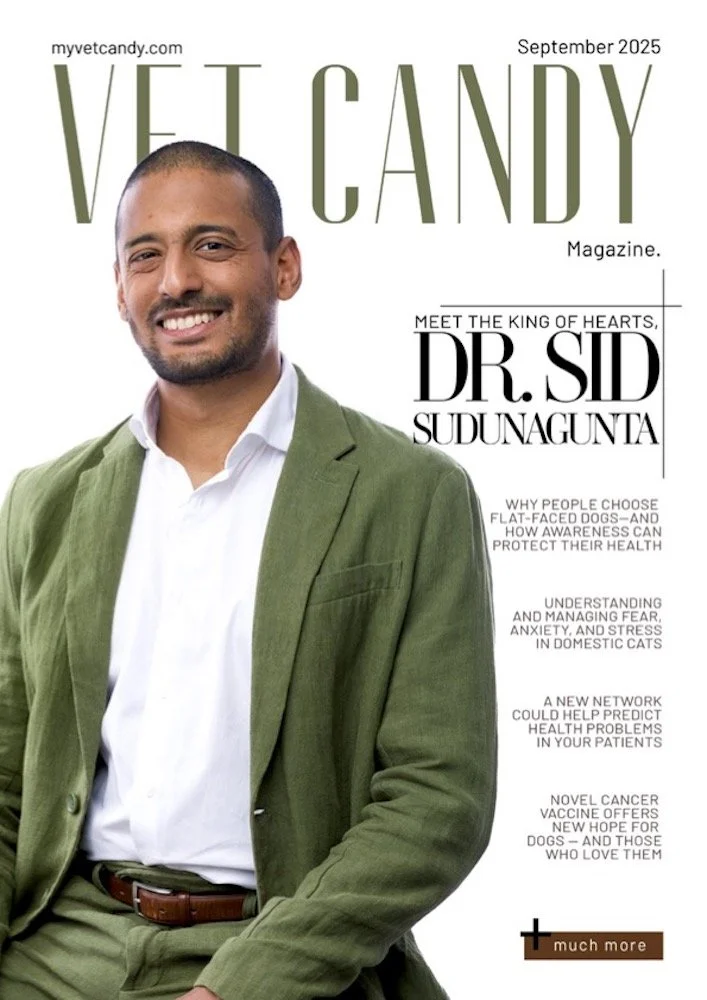
This month, we’re honored to spotlight UK’s Dr. Sid Sudunagunta, our cover star and the King of Hearts of veterinary cardiology. From his pioneering work in minimally invasive interventions to his passion for teaching (and his poker-faced love for cats named Havoc and Dorito), Dr. Sid reminds us that the best medicine blends expertise with humanity. Don’t miss his NAVLE prep collaboration with Vet Candy—because even the sharpest minds believe in sharing the knowledge.
Speaking of hearts, we’re celebrating a landmark moment in feline medicine: the FDA’s conditional approval of Felycin®-CA1, the first-ever drug for subclinical HCM in cats. For the 1 in 7 cats at risk, this isn’t just progress—it’s hope in a tablet. Meanwhile, our deep dive into feline HCM genetics reveals how much we’ve learned (and how much remains a mystery). Spoiler: Cats continue to outsmart us, but we’re catching up.
But it’s not all purrs and wagging tails. Our investigation into brachycephalic dogs uncovers a troubling truth: their behavior is shaped as much by human indulgence as by their squished snouts. And in California, wild pigs with neon-blue flesh are sounding the alarm on rodenticide risks—a vivid reminder that One Health isn’t just a slogan; it’s survival.
On the brighter side, Yale’s canine cancer vaccine is rewriting survival stories, while WSU’s genetic test for feline CKD proves prevention starts long before symptoms. And let’s not forget Dakota Kirk, the vet tech influencer turning fear into fascination—one scaly, feathered, or exoskeleton-clad patient at a time.
This issue is also a call to action:
For clinicians: Revisit how you handle feline
stress (hint: vertical space and hiding spots are
non-negotiable).
For researchers: The Dog Aging Project’s
comorbidity networks are a goldmine for
predicting disease—in dogs and humans.
For everyone: Try embracing body neutrality.
(Your mental health will thank you.)
As always, we’re here to inform, inspire, and occasionally make you laugh—because in this field, humor is as essential as a stethoscope.
